
Laboratory Glassware Washer vs. Manual Cleaning: Costs, Risks & ROI
13th Oct 2026
Laboratory Glassware Washer vs. Manual Cleaning: Is Your Lab Spending More Than It Needs To?
How much time does your laboratory spend washing glassware every week? And how much is that time actually costing you?
For many research laboratories, glassware cleaning is one of those routine jobs that rarely gets much attention until something goes wrong. A researcher discovers residue inside a flask. An analytical test produces an unexpected result. A technician spends another hour scrubbing equipment instead of preparing samples. Or an expensive piece of glassware breaks while being washed by hand.
Each incident may seem relatively minor. Together, however, inefficient cleaning practices can create an expensive bottleneck in an otherwise well-equipped laboratory.
That raises an important question: Is manual laboratory glassware cleaning still the most economical choice, or would an automated glassware washer provide better long-term value?
The answer depends on your laboratory's workload, contamination requirements, available staff, glassware types, and equipment budget.
In this guide, we'll compare manual and automated laboratory glassware cleaning, explore the real costs of both methods, examine contamination risks, and explain when investing in a professional laboratory washer makes financial and operational sense.
We'll also look at how professional equipment such as the Miele PLW 8505 Laboratory Glassware Washer can help research organizations standardize glassware-cleaning workflows.
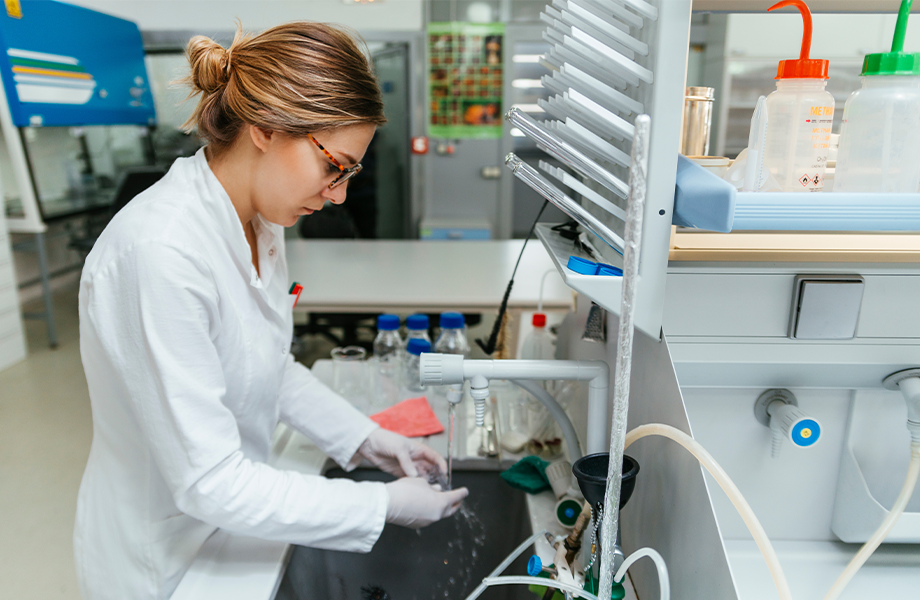
The Hidden Cost of Washing Laboratory Glassware by Hand
Manual washing often appears inexpensive because a laboratory already has a sink, water supply, detergent, brushes, and employees available to clean glassware.
But the absence of an equipment purchase doesn't mean the process is free.
Every minute a laboratory technician spends washing, rinsing, inspecting, and drying glassware is time that cannot be spent preparing experiments, processing samples, maintaining instrumentation, or completing other laboratory work.
And labor is only one part of the cost.
1. Labor and Lost Research Time
Consider a laboratory that cleans glassware multiple times throughout the day.
Each batch may involve collecting used glassware, removing residues, scrubbing internal surfaces, rinsing repeatedly, inspecting the results, and placing items in a drying area.
While experienced technicians can perform these tasks efficiently, repetitive handwashing still requires active employee participation.
With a properly selected automated laboratory washer, employees generally spend more of their time loading, unloading, inspecting, and documenting rather than performing every cleaning step manually.
That can create additional capacity for higher-value laboratory work, particularly in facilities with predictable daily glassware volumes.
2. Water and Chemical Consumption
Manual cleaning may involve repeatedly running water during washing and rinsing. Consumption depends heavily on employee technique, faucet flow, cleaning requirements, and how much glassware is processed.
Automated laboratory washers operate using defined water-fill, circulation, cleaning, and rinse stages.
Professional laboratory washers may reduce water consumption compared with certain manual cleaning procedures, but actual performance depends on the machine, program, batch size, and existing laboratory workflow.
Laboratories should compare water consumption per acceptable cleaned item, rather than looking only at water consumed per wash cycle.
3. Broken or Damaged Glassware
Anyone who has worked in a busy laboratory knows how easily a beaker, flask, or graduated cylinder can be damaged during handling.
Manual scrubbing introduces repeated handling and contact with brushes, sinks, and other glassware.
Automated washers can reduce some of that handling, but only when appropriate baskets, inserts, and injector accessories are used.
Improperly loaded glassware can still break in a machine.
For laboratories using expensive volumetric glassware or specialized laboratory vessels, replacement costs deserve a place in the financial comparison.
4. Rewashing and Unexpected Test Results
Sometimes glassware looks clean but still contains traces of detergent, dissolved minerals, or material from a previous experiment.
If contamination is discovered, the laboratory may need to repeat the cleaning process, prepare another sample, or investigate an analytical result.
The cost of a failed cleaning process therefore extends beyond the time spent washing the original item.
In analytical laboratories, even a small amount of unwanted residue may matter when measurements are sensitive to trace contaminants.
Manual vs. Automated Laboratory Glassware Cleaning: Side-by-Side Comparison
Automated cleaning can be an attractive alternative to handwashing, but it isn't necessarily the best choice for every application.
The following comparison highlights where each approach may offer advantages and where laboratories should evaluate their own procedures.

| Factor | Manual Cleaning | Automated Glassware Washer |
|---|---|---|
| Initial Investment | Typically low if sinks and cleaning equipment exist | Higher upfront equipment and installation cost |
| Hands-On Labor | Active washing and rinsing required | Primarily loading, unloading, inspection, and maintenance |
| Process Repeatability | Depends on technique and adherence to SOPs | Programmable and repeatable cleaning parameters |
| Rinse-Water Quality | Depends on available water and manual procedure | Models with DI connections can incorporate purified-water rinses |
| Narrow-Neck Glassware | May require specialized brushes and additional effort | Compatible injector accessories can clean internal surfaces |
| Operator Exposure | More direct interaction during cleaning | Enclosed processing can reduce some handling exposure |
| Documentation | Usually requires manually completed records | Program parameters may support documentation, depending on model |
| Maintenance | Brushes, sinks, and water-treatment equipment | Machine servicing, filters, spray arms, dosing, and water systems |
| Best Fit | Small workloads and specialized cleaning tasks | Recurring batches requiring consistent, repeatable cleaning |
The key distinction: Manual cleaning minimizes capital investment, while automated cleaning can reduce recurring hands-on work and standardize the process. Neither approach guarantees that a particular cleaning requirement has been met without an appropriate procedure and verification.
How Contaminated Glassware Can Affect Laboratory Results
Clean glassware is not simply about appearance.
A flask can look spotless and still contain residues that matter to the next experiment. In sensitive analytical work, those residues can contribute to background interference, unwanted reactions, sample contamination, or the need for additional troubleshooting.
Detergent and Cleaning-Agent Residues
If glassware is not rinsed adequately, cleaning agents may remain on its surfaces.
Depending on the analysis or reaction, these residues can affect measurements or chemical behavior.
Automated washers can use predefined rinse stages and, where equipped, demineralized-water connections. Appropriate procedures should still be established for the laboratory's actual cleaning requirements.
Mineral Deposits from Water
Water hardness and dissolved minerals can create visible spotting or less obvious residues on glassware.
For laboratories performing trace analysis, careful management of rinse-water quality may be especially important.
Laboratory washers with deionized or demineralized-water capabilities can help support a defined final-rinse process.
Carryover Between Experiments
A vessel previously used with catalysts, reagents, dyes, salts, or sample matrices may require a cleaning procedure tailored to those substances.
If residues carry over into the next experiment, researchers may need to investigate whether the results reflect the intended sample or unintended contamination.
This is one reason laboratories should treat glassware cleaning as part of their quality-control process rather than merely housekeeping.
Why Automation Can Help
A properly configured glassware washer can provide consistent temperatures, cleaning durations, detergent dosing, and rinse sequences across repeated cycles.
Standardization helps reduce variability associated with differences in individual cleaning technique.
However, the selected cleaning program must be appropriate for the glassware, residues, and required cleanliness level. A machine does not automatically eliminate contamination risks.
For additional laboratory equipment considerations, explore HiTechTrader's Laboratory Glassware Washer Selection.
Is Automated Washing Actually Cheaper? A Practical ROI Example
For a laboratory manager preparing an equipment purchase request, one of the most useful questions is how much employee time can realistically be recovered through automated glassware cleaning.
Consider this illustrative example.
Example: A Research Laboratory Cleaning Two Batches Per Day
Assume a laboratory has the following workflow:
- Two routine glassware batches per working day.
- 25 minutes of active labor per batch for manual washing, rinsing, and handling.
- 10 minutes of active labor per batch for machine loading, unloading, and inspection.
- 220 working days per year.
- An estimated fully loaded labor cost of $30 per hour.
The difference in active cleaning labor would be approximately 15 minutes per batch.
| Illustrative Metric | Result |
|---|---|
| Daily hands-on time saved | 30 minutes |
| Annual hours potentially recovered | 110 hours |
| Assumed fully loaded labor rate | $30 per hour |
| Annual labor value potentially recovered | $3,300 |
In this hypothetical example, the laboratory could free approximately 110 hours per year for other work.
Important: These numbers are illustrative assumptions, not measured savings from a Miele PLW 8505 or a guarantee that purchasing a washer will reduce payroll expenses. Financial savings depend on whether staff hours can actually be reduced or productively reassigned, and on the washer's operating and ownership costs.
What Else Belongs in the ROI Calculation?
A complete financial comparison should consider:
- Purchase price and installation costs.
- Employee labor for each cleaning method.
- Water, electricity, and cleaning chemicals.
- DI water production or procurement.
- Machine maintenance and service.
- Replacement baskets, inserts, and consumables.
- Glassware breakage and replacement.
- Cleaning failures, rewashing, and downtime.
- Expected equipment life and annual utilization.
For a basic payback estimate, divide the installed equipment investment by the expected annual net savings after subtracting incremental operating and maintenance costs.
A laboratory running several full cleaning cycles daily may reach a different result from a facility that only washes one small batch each week.
Five Signs Your Laboratory May Be Ready for a Glassware Washer
1. Your Staff Spend Too Much Time at the Sink
If glassware cleaning regularly interrupts sample preparation, analysis, or instrument operation, the active labor burden may justify reviewing an automated alternative.
2. Different Employees Produce Different Cleaning Results
Even with written procedures, differences in brushing, rinsing, detergent concentration, and inspection can create variation.
An automated process can reduce some of those differences by establishing repeatable machine parameters.
3. Your Laboratory Uses Large Amounts of Narrow-Neck Glassware
Volumetric flasks, bottles, and other narrow-neck items can be challenging to clean manually.
Professional laboratory washers equipped with appropriate injectors can direct cleaning fluid into compatible glassware interiors.
4. Your Team Frequently Rewashes Items
If technicians regularly discover spots, deposits, or incomplete cleaning, investigate the source water, chemistry, handling procedures, and current cleaning process.
An automated system may offer a more structured process, but the root causes still need to be addressed.
5. Your Lab Is Growing, but Staffing Is Not
Expanding research programs often create more demand for clean glassware without corresponding increases in laboratory support staffing.
Automated cleaning can help labs handle recurring workloads with less employee time spent on routine washing.
When Manual Cleaning Still Makes Sense
Automated washing isn't the right answer for every laboratory task.
Manual cleaning may remain appropriate when:
- The laboratory uses only small quantities of glassware.
- Equipment budgets or installation space are limited.
- Specific items are not approved for machine washing.
- Unusual residues require dedicated pre-treatment.
- Fragile or specialized components need a different cleaning method.
- A validated or manufacturer-approved manual procedure is required for particular equipment.
Some laboratories may benefit most from a hybrid workflow: automated cleaning for routine compatible glassware, with separate approved procedures for specialized items.
Laboratory personnel should also evaluate chemical hazards before washing. A glassware washer is not a substitute for proper hazardous-waste disposal, decontamination procedures, or chemical safety controls.
Choosing the Right Glassware Washer for Your Laboratory
Once a laboratory decides that automated washing may be worthwhile, the next step is choosing equipment that matches the facility's actual needs.
Capacity and Daily Workload
Estimate the number of glassware items or full batches processed each day.
Consider whether the workload arrives steadily or accumulates at specific times during laboratory shifts.
A smaller undercounter washer may be a strong fit for moderate recurring workloads, while larger research facilities may require high-capacity or pass-through equipment.
Glassware Shapes and Accessories
A washer is only as useful as its ability to clean the items your laboratory actually uses.
Consider whether you need injector baskets for narrow-neck vessels, holders for delicate glassware, or specialized racks for other labware.
Water Quality and Cleaning Chemistry
Evaluate incoming water hardness, the availability of DI water, required cleaning agents, and how thoroughly sensitive glassware must be rinsed.
Cleaning chemistry and the selected cycle must be compatible with the glassware and expected residues.
Electrical and Plumbing Requirements
Before ordering, confirm that your facility can provide the required circuit, water supplies, drainage, and installation space.
For example, the North American Miele PLW 8505 operates on 115V power but requires an appropriate 20A electrical connection. Voltage alone is not enough to establish installation compatibility.
If you're considering that model, review the equipment's installation documentation and ask your facilities team to assess the site before purchasing.
Spotlight: Miele PLW 8505 for Laboratories Ready to Automate
For research teams seeking to move beyond routine manual glassware cleaning, the Miele Professional PLW 8505 is worth evaluating.
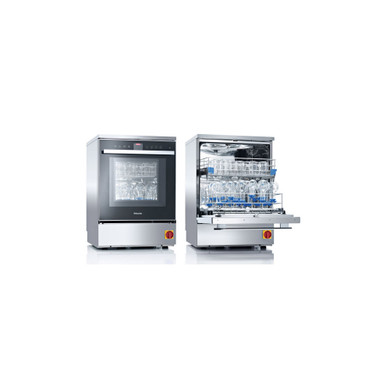
This undercounter laboratory glassware washer is designed for controlled cleaning of appropriate laboratory equipment and can be configured with specialized accessories for different glassware types.
Features Worth Considering
- Undercounter Format: Suitable for laboratories seeking a compact professional washer.
- 115V North American Configuration: Uses single-phase power with a properly rated 20A connection.
- DI Water Connection: Supports suitable rinse programs using demineralized water.
- Integrated Chemical Dosing: Two dispensing pumps for appropriate cleaning and neutralizing agents.
- Glassware Flexibility: Compatible accessories support different laboratory vessel shapes.
- Narrow-Neck Capacity: Miele describes configurations accommodating up to 39 narrow-neck items per cycle with the appropriate accessories.
The selected configuration, load carriers, cleaning programs, and installation requirements should be reviewed against the laboratory's actual needs.
View the Miele PLW 8505 at HiTechTrader and request pricing.
When Is a Larger Glassware Washer a Better Choice?
The PLW 8505 may suit many smaller and mid-sized laboratory applications, but laboratories with high throughput or centralized glassware-processing areas may need something larger.
High-capacity systems can be particularly relevant when:
- Multiple departments share a cleaning facility.
- Large batches must be processed on a predictable schedule.
- Glassware dimensions exceed the capacity of smaller equipment.
- Cleaning and receiving workflows need separate areas.
- Specialized documentation or process features are required.
HiTechTrader also offers alternatives such as the Miele G7825 Laboratory Glassware Washer.
You can explore additional models through HiTechTrader's Glassware Washers category or Miele Professional Glassware Washers selection.
How to Make the Business Case for an Automated Glassware Washer
If you're preparing a purchase request for a laboratory director, facilities manager, or procurement department, focus on measurable operational requirements rather than general promises about cleanliness or efficiency.
Start with a Two-Week Baseline
For two representative weeks, document:
- How many batches of glassware your laboratory processes daily.
- How much active employee time each batch requires.
- The most common glassware types and cleaning difficulties.
- How often items require rewashing.
- Approximate water and cleaning-agent consumption.
- Any recurring glassware breakage or replacement costs.
Then Build a Purchase Comparison
Use the baseline to compare your current process with the expected workflow of a suitable automated washer.
Request information about the purchase price, racks, injector accessories, installation requirements, warranty, maintenance, and ongoing cleaning chemicals.
Rather than assuming the machine will save a particular percentage of labor or water, use your own facility's measurements and the manufacturer's program data.
That approach produces a more credible capital equipment justification and makes it easier to evaluate the outcome after installation.
Frequently Asked Questions: Laboratory Glassware Washers vs. Handwashing
Is a laboratory glassware washer better than washing by hand?
For recurring volumes of compatible glassware, automated washing can reduce hands-on cleaning and standardize process variables. Manual washing may remain appropriate for small workloads or specialty items. The correct choice depends on workload, residue type, cleaning requirements, and cost.
Can a laboratory glassware washer remove chemical contamination?
A properly configured washer can remove many types of compatible residues using suitable cleaning chemistry, mechanical action, temperatures, and rinse stages. Cleaning effectiveness must be established for the specific contamination and glassware involved.
Does a laboratory glassware washer sterilize glassware?
Not automatically. Cleaning, thermal disinfection, and sterilization are different processes. Whether a machine provides disinfection or sterilization depends on its design, program, and validated operating conditions. Do not assume that a standard wash cycle produces sterile glassware.
Can automated washing reduce water consumption?
It may. Water use depends on the selected washer, program, load size, and existing handwashing procedure. The appropriate comparison is total water consumed per acceptable cleaned item or representative batch.
Are automated washers suitable for volumetric flasks?
Many laboratory washers support narrow-neck vessels using appropriate injector accessories. Confirm the compatibility of the specific glassware and cleaning program, particularly where calibrated or specialized vessels are involved.
How long does it take for a glassware washer to pay for itself?
Payback depends on equipment investment, daily utilization, labor time recovered, utility costs, consumables, maintenance, and existing cleaning expenses. Laboratories should calculate payback using their own operational data rather than assuming a universal return.
What is the difference between a laboratory washer and a household dishwasher?
Professional laboratory glassware washers are designed around laboratory vessel shapes, specialized cleaning accessories, defined chemical dosing, and relevant water-quality and process requirements. A household dishwasher is not a direct substitute for a laboratory-specific cleaning process.
Is the Miele PLW 8505 suitable for research laboratories?
The PLW 8505 is designed for professional laboratory glassware cleaning and is worth considering for academic, analytical, industrial, and research facilities. Suitability depends on required cleaning procedures, available accessories, capacity, and facility infrastructure.
The Bottom Line: Cleaning Glassware Shouldn't Hold Back Your Laboratory
Handwashing will always have a role in laboratory operations. But when technicians spend significant time cleaning routine glassware, when residues repeatedly create problems, or when laboratory throughput begins outgrowing existing workflows, it may be time to evaluate a professional glassware washer.
The strongest reason to invest isn't simply that a machine can wash glassware.
It's the opportunity to create a more repeatable cleaning process, reduce unnecessary hands-on work, and make better use of laboratory resources.
For facilities evaluating automated glassware washing, HiTechTrader offers Miele Professional equipment, including the undercounter PLW 8505, along with additional professional glassware washer options.
Is Your Laboratory Ready to Upgrade Its Glassware Cleaning?
Stop guessing whether manual washing is still the most economical option.
Let HiTechTrader help you compare professional laboratory glassware washers based on your equipment requirements, glassware types, available space, and purchasing budget.
Since 1982, HiTechTrader has supplied scientific equipment to research organizations, universities, industrial laboratories, and other scientific equipment buyers.
Explore the Miele PLW 8505 & Request a Quote
Call: 609-518-9100
Email: sales@hitechtrader.com
Compare Equipment: Browse Laboratory Glassware Washers
HiTechTrader — Supporting Scientific Research Since 1982.