
Parr 4561 vs 4562 vs 4568: Which 4560 Series Reactor Is Right for Your Lab?
5th Oct 2026
Parr 4561 vs 4562 vs 4568: Which 4560 Series Reactor Is Right for Your Lab?
For most labs, the Parr 4561 is the best fit when small-batch screening and easy vessel handling matter most, the Parr 4562 is the middle ground choice for more working volume without moving to a fixed-head system, and the Parr 4568 is the better fit when 600 mL capacity and repeated fixed-head operation are priorities.

The model number, however, is only the starting point. Vessel material, gasket type, maximum pressure and temperature, stirring hardware, controller, heater, valves and other included components can matter just as much as nominal volume when choosing a high-pressure laboratory reactor.
Key Takeaways
- Parr 4561: approximately 300 mL with a moveable head configuration.
- Parr 4562: approximately 450 mL with a moveable head configuration.
- Parr 4568: approximately 600 mL with a fixed head configuration.
- Standard Parr Series 4560 systems are commonly rated up to 3000 psi MAWP, although the exact safe limit depends on the individual vessel and configuration.
- Choose the vessel alloy based on the chemistry first. A corrosion resistant Alloy 600 or C-276 reactor may be a better choice than a stainless steel reactor of the “ideal” size when aggressive chemicals are involved.
- When buying used, compare the complete reactor system, not just the vessel model number.
Choosing the Right Parr 4560 Series Reactor
The Parr 4560 Series is widely used for laboratory-scale high-pressure reactions, catalyst studies, hydrogenation, chemical synthesis, polymer research, process development and other demanding applications where researchers need controlled temperature, pressure and agitation.
At first glance, the Parr 4561, 4562 and 4568 can appear very similar. All belong to the same general reactor family, but their differences become important once you consider actual laboratory workflow.
Three models frequently found on the used- quipment market are the Parr 4561, Parr 4562 and Parr 4568. The 4561 and 4562 use a moveable-head vessel design, while the 4568 uses a fixed-head design.
The approximate vessel capacities are:
- Parr 4561: 300 mL
- Parr 4562: 450 mL
- Parr 4568: 600 mL
That combination of vessel size and head configuration is often the first major decision point when selecting between these reactors.
Current HiTechTrader examples: compare the Parr 4561 300 mL reactor , Parr 4562 450 mL reactor and Parr 4568 600 mL reactor .
You can also browse all Parr Instruments inventory and current laboratory reactors.
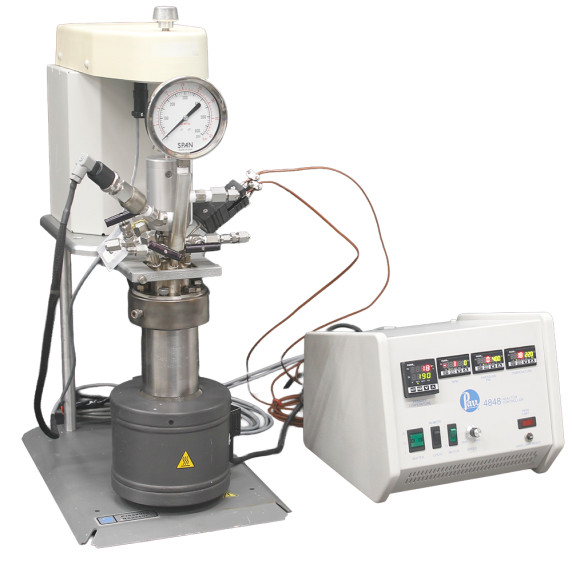

Parr 4561 vs 4562 vs 4568: Quick Comparison
| Model | Approx. Capacity | Head Style | Best Fit |
|---|---|---|---|
| Parr 4561 | 300 mL | Moveable head | Small-batch screening, catalyst development and applications where reagent consumption should remain low. |
| Parr 4562 | 450 mL | Moveable head | General synthesis and process development that requires more capacity while retaining a removable vessel design. |
| Parr 4568 | 600 mL | Fixed head | Larger laboratory batches, scale-up work and repeated operation where the reactor remains mounted. |
Parr lists the standard Series 4560 maximum allowable working pressure at up to 3000 psi, with actual pressure and temperature capability depending on the exact vessel, gasket, materials of construction and system configuration.
High-temperature versions can have different limits, so buyers should verify the reactor identification plate, vessel specifications and complete configuration instead of assuming that every reactor carrying the same basic model number has identical operating limits.
Parr 4561: Best for Small-Batch Screening and Development
The Parr 4561 is a particularly attractive option when laboratory work involves expensive catalysts, limited raw materials or repeated experimental screening.
Its approximately 300 mL capacity can reduce the amount of reagent required for each run while still providing enough material for analytical work and early-stage process development.
The moveable-head configuration can also make loading, unloading and cleaning convenient when the vessel needs to be removed from the reactor stand regularly.
When the Parr 4561 makes sense
- Catalyst screening
- Hydrogenation studies
- Small-batch chemical synthesis
- Research involving expensive reagents
- Method development
- Early-stage process optimization
- Applications where the vessel is frequently removed for cleaning
For many research laboratories, a smaller reactor also provides an important economic advantage: failed experiments consume less material.
That can become significant when reactions involve high-value catalysts, specialty chemicals or compounds that are difficult to synthesize.
Parr 4562: The Middle Ground Option
The Parr 4562 occupies an interesting position between the smaller 4561 and larger 4568.
With approximately 450 mL of nominal capacity, it provides more room for larger reaction charges while retaining the moveable-head arrangement.
This can make it a strong choice for laboratories that have outgrown a 300 mL vessel but do not necessarily need a 600 mL fixed-head system.
The Parr 4562 may be a good fit when:
- 300 mL does not provide enough usable reaction volume.
- You want to retain the convenience of a moveable-head reactor.
- You need enough final product for additional analytical or downstream processing.
- You are transitioning from early screening toward process development.
- A 600 mL system would increase reagent costs unnecessarily.
Parr 4568: Best for Larger Laboratory Batches
The Parr 4568 provides approximately 600 mL of nominal vessel capacity and uses a fixed-head configuration.
That larger size can be particularly useful when researchers need enough product from a single run for purification, formulation, physical testing or additional downstream analysis.
The fixed-head arrangement can also be convenient for repeat processes because much of the reactor hardware remains positioned consistently between runs.
Applications where a Parr 4568 may make more sense include:
- Process-development work
- Scale-up from smaller laboratory reactors
- Repeated high-pressure synthesis
- Applications requiring larger quantities of product
- Research programs where downstream testing requires more sample material
Moveable Head vs Fixed Head
One of the most important differences between these models is the reactor-head configuration.
The Parr 4561 and 4562 are moveable-head systems. This design can be convenient when you want to remove the vessel for loading, cleaning or handling outside of the reactor stand.
The Parr 4568 uses a fixed-head arrangement, which can be preferable for laboratories that perform repeated experiments using a consistent setup.
Neither configuration is automatically superior.
The better choice depends on factors such as:
- How frequently the vessel must be opened
- How the vessel is cleaned
- The weight of the charged vessel
- How often fittings are disconnected
- Operator preferences
- The number of repeated runs being performed
- Whether leaving the head and fittings in a consistent position improves workflow
300 mL vs 450 mL vs 600 mL: How Much Volume Do You Really Need?
Choosing reactor size should involve more than simply determining how much liquid will fit into the vessel.
The practical difference between a 300 mL, 450 mL and 600 mL reactor affects:
- Reagent consumption
- Catalyst requirements
- Heating and cooling behavior
- Agitation
- Gas headspace
- Sampling volume
- Reaction expansion
- Foaming
- Gas-liquid contact
- Quantity of final material produced
A laboratory screening expensive catalysts may intentionally choose the 4561 because a smaller batch keeps experimental costs low.
A process-development team may prefer the 4568 because one successful run can generate enough material for purification, analytical testing and additional process steps.
Application Examples: Which Reactor Fits Which Job?
| Application | Likely Fit | Why |
|---|---|---|
| Catalyst screening or expensive chemistry | 4561 | Lower reagent demand and compact batch size make repeated screening easier to justify economically. |
| General synthesis and method development | 4562 | Provides more capacity than the 4561 while retaining a moveable-head configuration. |
| Scale-up studies or larger downstream sample requirements | 4568 | The 600 mL nominal volume can provide more product per run, and the fixed-head arrangement may suit repeat workflows. |
| Corrosive chemistry | Depends on alloy | Material compatibility can outweigh volume. Alloy 600 or C-276 may be more important than choosing the otherwise ideal model size. |
Vessel Material May Matter More Than Model Number
One of the most important decisions when choosing a high-pressure reactor is the material of construction.
Parr 4560 Series vessels can be configured in materials including:
- T316 stainless steel
- Alloy 600 / Inconel-type material
- Alloy C-276 / Hastelloy-type material
HiTechTrader frequently handles stainless-steel, Inconel/Alloy 600 and Hastelloy-type Parr reactor systems.
For aggressive or corrosive chemistry, selecting the correct material can be substantially more important than choosing between 300, 450 or 600 mL.
For example, a laboratory may initially prefer a 4561 because of its size but discover that an Alloy 600 4568 is actually the better purchase because the alloy is more compatible with the intended chemical process.
For more detail, read: Inconel 600 vs Hastelloy C-276 vs 316 Stainless Steel for High-Pressure Reactors .
Temperature and Gasket Selection
A reactor's temperature capability depends on more than the metal vessel.
Gasket and seal selection can affect allowable operating temperature, chemical compatibility and pressure performance.
When buying a used Parr reactor, verify:
- Vessel alloy
- Installed gasket type
- Maximum rated temperature
- Maximum allowable working pressure
- Head configuration
- Valve configuration
- Agitation components
- Pressure-relief hardware
Do not assume that two reactors with the same 4561, 4562 or 4568 model designation have exactly the same capabilities.
Do Not Overlook the Parr Controller
Two used Parr reactors with identical vessel model numbers can represent very different purchases.
One system may include a Parr 4848 controller, heater, motor, magnetic drive, thermocouple, cooling coil, pressure gauge and complete reactor stand.
Another listing may contain little more than the vessel.
Before comparing price, determine exactly what is included.
Important components to verify include:
- Parr controller model
- Temperature input and thermocouple
- Heater compatibility
- Drive motor
- Magnetic stirrer drive
- Agitator shaft and impeller
- Pressure gauge
- Rupture-disc assembly
- Gas inlet valve
- Liquid sampling valve
- Cooling coil
- Electrical requirements
- Support stand
A seemingly inexpensive reactor can become the more expensive option if several critical components must be purchased separately.
Why Mixing and Agitation Matter
As reactor volume increases, agitation becomes increasingly important.
High-pressure reactions may involve gas-liquid systems, suspended catalysts or multiphase mixtures. In those applications, adequate mixing can influence reaction rate, heat transfer and repeatability.
When evaluating a used system, inspect the motor and magnetic drive and determine whether the installed impeller is appropriate for the intended chemistry.
Moving from a 300 mL reactor to a 600 mL reactor does not necessarily mean a process can simply be doubled without additional development.
Mixing behavior, headspace, temperature gradients and gas transfer can all change during scale-up.
What Changes When You Scale from a 4561 to a 4568?
The move from a 300 mL Parr 4561 to a 600 mL Parr 4568 approximately doubles nominal vessel capacity, but successful scale-up involves more than doubling every ingredient.
Important factors can include:
- Impeller geometry
- Agitation speed
- Gas-liquid mass transfer
- Heat-up rate
- Cooling capacity
- Surface area to volume ratio
- Headspace
- Catalyst concentration
- Sampling requirements
If a reaction has significant exothermic behavior, scale up should be approached especially carefully because heat-removal requirements may change.
Which Parr 4560 Series Reactor Should You Choose?
Choose the Parr 4561 if:
- You want a compact 300 mL reactor.
- You perform small-batch experimental work.
- Your reagents or catalysts are expensive.
- You prefer a moveable-head configuration.
- You are primarily performing screening or early process development.
Choose the Parr 4562 if:
- You need more capacity than 300 mL.
- You still prefer a moveable-head reactor.
- You need enough product for additional testing.
- You want a middle ground between screening and larger-scale laboratory work.
Choose the Parr 4568 if:
- You need approximately 600 mL nominal capacity.
- You perform larger laboratory batches.
- You need additional product for downstream testing.
- You prefer a fixed-head configuration.
- You perform repeat reactions using a consistent setup.
Choose based on alloy instead of volume if:
- Your chemistry is strongly corrosive.
- Chlorides, acids or other aggressive chemicals are involved.
- Stainless steel does not provide adequate compatibility.
- The process requires Alloy 600 or Alloy C-276 construction.
Used Parr Reactor Buying Checklist
- Photograph and record the vessel nameplate and model/serial information.
- Confirm the vessel material, including wetted internal components where possible.
- Inspect the closure surfaces.
- Inspect fittings and valves.
- Verify the pressure gauge range.
- Check the rupture-disc assembly.
- Verify gasket type and corresponding temperature limitation.
- Confirm the controller is included.
- Confirm the heater is included.
- Confirm the motor and agitation system are included.
- Verify the magnetic drive is present and appropriate for the application.
- Check whether a cooling coil is installed.
- Confirm electrical requirements before shipment.
- Determine whether the reactor was tested.
- Ask exactly what functionality was verified during testing.
Frequently Asked Questions
What is the difference between the Parr 4561 and Parr 4568?
The Parr 4561 has approximately 300 mL nominal capacity and uses a moveable-head configuration. The Parr 4568 has approximately 600 mL nominal capacity and uses a fixed-head configuration.
What is the difference between the Parr 4561 and 4562?
Both are moveable-head reactors in the Parr 4560 Series. The major difference is vessel capacity: the 4561 is approximately 300 mL while the 4562 is approximately 450 mL.
How large is a Parr 4568 reactor?
The Parr 4568 has an approximate nominal vessel capacity of 600 mL.
What pressure can a Parr 4560 Series reactor handle?
Parr lists standard Series 4560 systems at up to 3000 psi maximum allowable working pressure. The exact allowable pressure and temperature depend on the specific vessel, gasket, materials of construction and configuration. Always verify the individual equipment nameplate and documentation.
Is 600 mL the working volume of a Parr 4568?
Not necessarily. The 600 mL figure represents nominal vessel capacity. Recommended working volume may be lower depending on the reaction, required headspace, foaming, gas generation, agitation and other process considerations.
What is a Parr 4848 controller?
The Parr 4848 is a reactor controller commonly paired with Parr laboratory reactor systems. Depending on configuration, it may provide temperature control and support other reactor operating functions.
Is a used Parr reactor worth buying?
A used Parr reactor can be an excellent alternative to purchasing new equipment when the vessel, safety components, controller and accessories are properly evaluated and the system matches the intended application.
Used equipment can also provide access to configurations that are immediately available rather than requiring factory lead time.
Should I choose stainless steel, Inconel or Hastelloy?
The correct material depends on your chemistry, temperature, pressure and corrosion requirements. Stainless steel is suitable for many applications, while Alloy 600 and C-276 may provide better corrosion resistance for more aggressive processes.
See our detailed reactor material comparison for more information.
Technical References
For specifications and process planning, HiTechTrader recommends verifying the exact reactor configuration against the manufacturer's technical documentation.
Manufacturer specifications can vary by configuration and revision. Always confirm the exact unit nameplate, accessories and manual before installation or operation.
Related HiTechTrader Guides
- Inconel 600 vs Hastelloy C-276 vs 316 Stainless Steel for High-Pressure Reactors
- How to Choose a Parr Reactor by Volume, Pressure, Temperature and Material
- Sell Used Parr Reactors and Pressure Vessels
Need Help Choosing a Parr Reactor?
Choosing between a Parr 4561, 4562, 4568 or another high pressure reactor configuration depends on much more than capacity.
Send HiTechTrader your required volume, pressure, temperature, chemistry and preferred materials of construction. We can help match your application to available inventory and help source difficult-to-find Parr systems.
Contact HiTechTrader for Current Parr Reactor Availability
You can also browse our current laboratory reactor inventory or all available Parr Instruments equipment .