


Fall Savings:
15% Off Select Items For A Limited Time
Contact Us To Save

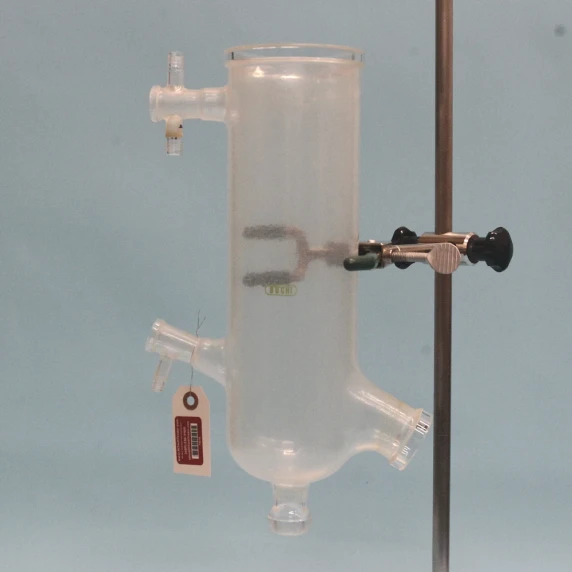
Plastic-Coated Glass | Constant-Feed Condenser Configuration | 19/38 Angled Addition Joint | Style C Assembly | Outer Sleeve Only | Used Laboratory Glassware
What happens when your laboratory needs to concentrate more solution than a single rotary evaporator flask can hold?
With a conventional batch rotary evaporation setup, the answer often involves stopping the process, breaking vacuum, removing or refilling the evaporating flask, and restarting the system. When multiple liters of solvent must be processed, those interruptions can consume valuable laboratory time.
A constant-feed rotary evaporator configuration offers another approach.
The used Buchi Style C Cold Trap Outer Sleeve is a specialized glassware component for a compatible rotary evaporator condenser assembly featuring a continuous-feed connection and an angled 19/38 outer joint.
Designed for use as the outer sleeve of a Style C cold-trap condenser, this plastic-coated glass component is associated with a system that allows additional solution to be introduced during rotary evaporation, potentially extending processing beyond the volume of the original evaporating flask.
The angled addition-joint arrangement is particularly important. It is designed to allow condensed solvent to travel toward the receiving flask rather than flowing back along the addition tube into the evaporating flask.
For organic chemistry laboratories, pharmaceutical research groups, process-development teams, and technicians maintaining existing Buchi rotary evaporators, this component offers an alternative to replacing an entire glassware assembly when only the outer sleeve requires replacement.
Offered in used condition by HiTechTrader, supplying laboratory and scientific equipment since 1982.
Important: Outer Sleeve Only
This listing is for the outer glass sleeve of a Buchi-style constant-feed Style C cold-trap condenser assembly. It is not a complete condenser or rotary evaporator. The inner cold finger, seals, lid, fittings, feed stopcock, tubing, and other assembly components are not assumed to be included.
Most laboratory rotary evaporators are used in batch operation. Researchers place a solution in the evaporating flask, apply appropriate heat and vacuum, recover solvent, and stop the process when the required concentration is achieved.
This works well for many applications, but the flask's usable capacity can become a practical limitation when processing larger total solution volumes.
Constant-feed condenser configurations provide an additional connection through which solution can be introduced into the evaporating flask while the equipment operates under appropriate conditions.
The Buchi Style C outer sleeve is designed around this concept.
The condenser arrangement includes an additional 19/38 outer glass joint sealed at an angle.
This joint is associated with the system's continuous-feed connection, enabling compatible tubing and feed-control components to introduce additional solution into the evaporating flask.
The angled geometry is engineered so that condensate can drain toward the receiving flask without traveling down the addition tube and returning to the evaporating flask.
That distinction helps separate two important paths within the rotary evaporation process:
By maintaining these intended flow paths, the condenser design supports the operation of a constant-feed rotary evaporation system.
Note: The outer sleeve alone does not provide continuous-feed operation. The complete assembly requires suitable internal condenser components, tubing, valves, seals, and other compatible equipment.
A rotary evaporator's flask capacity does not necessarily determine the total amount of solution that can be processed during a laboratory workflow.
In an appropriately configured constant-feed system, additional liquid can be introduced as solvent is removed, allowing the laboratory to process a total volume larger than the flask's nominal capacity over time.
This can be especially useful when researchers need to concentrate large quantities of dilute solution, recover solvent from multiple samples, or prepare materials for further purification.
The actual feed rate must remain compatible with evaporation rate, thermal capacity, vacuum conditions, and the system's safe working volume.
For laboratories performing repeated solvent concentration work, manual refilling can become a significant part of the operating procedure.
With a properly configured constant-feed arrangement, researchers may be able to reduce the frequency of process interruptions associated with manually refilling the evaporation flask.
This can support more convenient handling of compatible larger-volume workflows and allow laboratory personnel to concentrate on monitoring the evaporation process.
Continuous feeding does not eliminate the need for supervision, appropriate process controls, or safe handling of receiving-flask capacity.
Chemical research often involves concentrating solutions to a target volume or recovering solvent before downstream analysis.
When an evaporation process requires several flask refills, operating conditions may need to be re-established after each interruption.
A constant-feed system can provide another approach by allowing additional solution to enter during operation, subject to the limitations of the complete system.
For process-development teams, this may be useful when evaluating solvent-removal strategies, process throughput, and laboratory handling requirements.
A Style C cold-trap condenser is different from a conventional single-piece cooling-coil condenser.
The cold-trap arrangement uses multiple components, including an outer glass body and a separate internal cooling element commonly called a cold finger.
In a complete, compatible assembly, these components work together to provide the surfaces and vapor path needed for solvent condensation and collection.
The outer sleeve forms an important part of the glass condenser body and provides the external connection geometry required for the assembly.
Because this particular version is associated with a constant-feed configuration, the additional angled 19/38 connection is an important feature when identifying a replacement.
Understanding the distinction can prevent expensive ordering mistakes.
| Component | Purpose |
|---|---|
| Outer Glass Sleeve | Forms the external condenser body and incorporates connection geometry, including the constant-feed joint in this configuration. |
| Inner Cold Finger | Provides the cooled internal condensation surface when installed with the complete assembly. |
| Centering and Sealing Components | Help position the internal components and maintain the intended seal when appropriately assembled. |
| Feed Valve and Tubing | Provide a controlled connection for introducing additional solution during operation. |
| Receiving Flask | Collects condensed solvent recovered during rotary evaporation. |
Replacing a damaged outer sleeve may be more economical than purchasing a complete condenser assembly when the remaining components are serviceable and compatible.
For more information about identifying replacement glassware, read The Smart Guide to Used Rotary Evaporator Parts & Equipment.
This Buchi Style C condenser outer sleeve is described as plastic-coated glass.
Laboratory rotary evaporator glassware is frequently exposed to vacuum conditions, solvent vapors, repeated handling, and assembly changes.
An external plastic coating may provide additional fragment-retention characteristics in some breakage scenarios, depending on the coating material, condition, and intended manufacturer design.
For laboratories working with glass components around vacuum equipment, coating condition is an important detail to evaluate.
A plastic coating does not make glassware unbreakable and should not be interpreted as a guarantee of vacuum safety or chemical compatibility.
For this used component, the present coating condition should be confirmed through photographs or additional inspection information.
| Specification | Details |
|---|---|
| Product Identification | Buchi Style C Cold Trap Outer Sleeve |
| Condition | Used |
| Product Type | Rotary Evaporator Condenser Outer Glass Sleeve |
| Assembly Style | Style C Cold-Trap Condenser |
| Feed Configuration | Constant Feed / Continuous Feed |
| Additional Joint | 19/38 Outer Glass Joint |
| Feed Joint Orientation | Angled Connection |
| Material | Plastic-Coated Laboratory Glass |
| Condenser Construction | Outer Sleeve for Multi-Component Cold-Trap Assembly |
| Primary Application | Rotary Evaporation and Solvent Recovery |
| Supplied Component | Outer Sleeve Only |
| Exact Manufacturer / OEM Part Number | Not independently confirmed for this used unit |
| Compatible Rotavap Models | Must be verified against the existing condenser assembly and equipment documentation |
| Condition of Coating and Joints | Request current condition details |
Identification Note: This description is based on the supplied product information and the documented Style C constant-feed condenser design. Similar components are offered by different glassware manufacturers. Exact part numbers, OEM origin, coating composition, overall dimensions, and model fitment must be confirmed for this specific used item.
Organic chemistry laboratories frequently use rotary evaporators to remove solvents after extraction, synthesis, purification, and sample-preparation procedures.
When total solution volume exceeds the capacity of the evaporating flask, an appropriately configured constant-feed assembly can allow solution to be introduced over the course of the process.
This is useful for laboratories concentrating dilute reaction mixtures or processing multiple compatible solution portions.
Pharmaceutical research laboratories often need to concentrate reaction mixtures, recover solvents, and prepare intermediates for further analytical or purification work.
For compatible evaporation systems, continuous-feed glassware may help reduce repeated manual flask refilling while supporting larger-volume laboratory workflows.
Teams managing frequent solvent-removal tasks may find the availability of replacement Style C components valuable for keeping established equipment in service.
Research involving botanical extracts, natural products, and other dilute solutions can generate more liquid than a laboratory evaporating flask can handle in a single charge.
A properly configured constant-feed rotary evaporator offers a potential method for processing additional solution without requiring a separate flask-loading step each time.
Actual suitability depends on viscosity, suspended solids, solvent composition, foaming behavior, and the system's operating limits.
University chemistry departments often maintain rotary evaporators for use by multiple researchers and graduate students.
Replacing a damaged cold-trap outer sleeve can help preserve an existing system when the remaining equipment is compatible and in satisfactory condition.
For research departments managing equipment budgets, sourcing individual used components may provide an alternative to purchasing complete replacement glassware assemblies.
Contract research organizations and process-development laboratories often work with changing batch sizes and different solvent systems.
Continuous-feed rotary evaporation can be relevant when teams are studying solvent-removal throughput, sample concentration, and practical process handling.
Having access to specialized replacement glassware helps laboratories maintain existing equipment rather than automatically investing in a new evaporator.
Rotary evaporator condenser selection depends on the instrument's mechanical configuration, thermal requirements, and the intended research workflow.
A traditional coil condenser commonly uses an internal glass cooling coil through which cooling fluid circulates.
A Style C cold-trap condenser uses a different arrangement with a separate internal cold finger and outer glass body.
The constant-feed version of the Style C design adds a specialized connection for introducing additional solution during operation.
Explore HiTechTrader's distillation equipment and laboratory glassware selection when comparing alternative components.
Laboratory glassware is often the most vulnerable part of an otherwise functional rotary evaporator.
Over time, components may require replacement due to accidental damage, chemical exposure, assembly wear, or changes in laboratory requirements.
If the rotary evaporator drive, vacuum components, heating bath, condenser cold finger, and other equipment remain serviceable, replacing the damaged outer sleeve may help avoid unnecessary capital expenses.
Read HiTechTrader's article Exploring the World of Used Rotary Evaporator Parts for more information on the role of replacement components in laboratory equipment purchasing.
Because rotary evaporator glassware can look similar across multiple manufacturers and model generations, buyers should verify fitment carefully.
Before purchasing this used Buchi Style C outer sleeve, confirm the following:
Some Buchi Rotavapor families use Style C cold-trap configurations, including historical R-114/R-144 and R-200/R-205 equipment. However, the presence of a Style C condenser option on those models does not establish compatibility with this exact used constant-feed outer sleeve.
For additional Buchi replacement information, visit HiTechTrader's guide to replacing Buchi Rotavap vapor ducts.
Solvent recovery depends on more than one glassware component.
A complete rotary evaporation setup typically includes an evaporating flask, vapor duct, compatible condenser, receiving flask, vacuum system, and suitable heating and cooling equipment.
For a constant-feed Style C arrangement, the laboratory must also consider the feed-control components and the integrity of the complete vacuum and condensate paths.
When planning or updating your laboratory workflow, consider the following complementary equipment:
Browse laboratory equipment, explore distillation systems, or review Lab-Scale vs. Process-Scale Rotary Evaporators for additional equipment-selection guidance.
Since 1982, HiTechTrader has served laboratories, universities, industrial research groups, and scientific equipment buyers seeking specialized instruments and components.
For equipment managers, finding the correct replacement component is often just as important as selecting an entirely new instrument.
A used condenser sleeve can be particularly valuable when maintaining an older system or replacing a specialized glass component that is difficult to source.
Explore HiTechTrader's used laboratory glassware, distillation equipment, and complete scientific equipment inventory.
It is the outer glass component of a compatible Style C rotary evaporator cold-trap condenser. The outer body works with additional condenser components to form the complete assembly.
This configuration features an additional angled 19/38 outer joint designed for a continuous-feed arrangement. It enables a properly configured rotary evaporator to receive additional solution during the evaporation process.
Yes. A complete, properly configured constant-feed system can introduce additional solution over time, allowing total processed volume to exceed the evaporating flask's nominal capacity. Safe fill level and operating limits must still be observed.
The angled connection is designed to support the intended feed and condensate flow paths, allowing condensed solvent to drain toward the receiving flask rather than back down the addition tube toward the evaporating flask.
No. This offering is for the outer glass sleeve only. The complete cold-trap assembly requires additional parts, including a compatible inner cold finger and sealing components. Contact HiTechTrader to verify which accessories, if any, are supplied.
The supplied product information describes it as plastic-coated glass. The current coating condition should be verified for this used component.
No. Compatibility depends on the exact rotary evaporator model, condenser configuration, glassware dimensions, and required seals and connections. Buyers should compare the original component against the replacement before ordering.
Organic chemistry laboratories, pharmaceutical R&D groups, university research facilities, natural-product laboratories, and process-development teams may use constant-feed evaporation for suitable larger-volume solvent concentration workflows.
Potentially. If the remaining condenser components and the rotary evaporator are functional and compatible, replacing the damaged outer sleeve may be an economical alternative to replacing the complete instrument.
This Buchi Style C cold-trap condenser outer sleeve is offered in used condition. Contact HiTechTrader to request current photographs, condition details, and available accessory information.
HiTechTrader offers laboratory glassware and specialized scientific equipment. Explore the laboratory glassware inventory or read the used rotary evaporator parts guide.
When a rotary evaporator is otherwise functional, a damaged condenser component should not automatically mean replacing the entire system.
The used Buchi Style C Plastic-Coated Cold Trap Outer Sleeve with Constant-Feed 19/38 Joint provides a specialized replacement option for laboratories maintaining compatible rotary evaporation equipment.
Its distinguishing feature is the angled continuous-feed connection, designed to support the introduction of additional solution while allowing condensate to drain toward the receiving flask in the assembled system.
For laboratories seeking specialized used glassware, replacement condensers, and rotary evaporator components, this is a product worth evaluating carefully against the original assembly.
Repair the right component. Preserve your existing equipment investment.
Contact HiTechTrader for pricing, availability, current condition photographs, glassware identification, and shipping information.
To help evaluate fitment, please provide your rotary evaporator model, the original condenser part number if available, and photographs or measurements of the existing outer sleeve.
Call: 609-518-9100
Email: sales@hitechtrader.com
Browse: Shop Laboratory Glassware & Replacement Components
HiTechTrader — Your Scientific Equipment Resource Since 1982.


