New


Fall Savings:
15% Off Select Items For A Limited Time
Contact Us To Save
Chemglass lab glassware
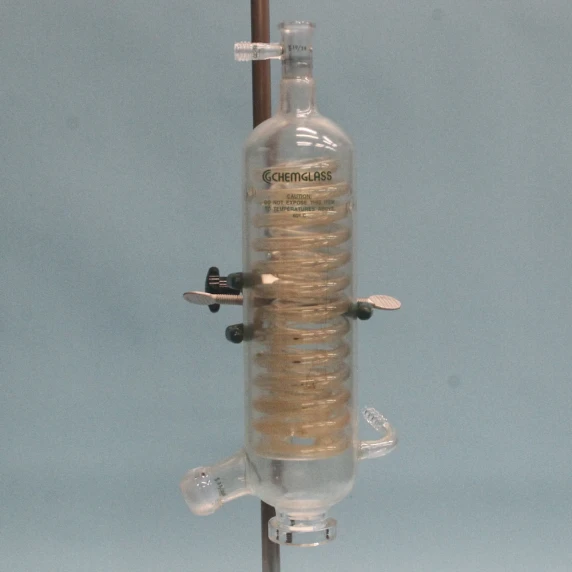
ChemGlass CG-1326-10 Double-Coil Rotary Evaporator Condenser
Product Code:
15635
Condition:
Used
$400.00

Used Chemglass CG-1326-10 Double-Coil Rotary Evaporator Condenser
Chemglass Part CG-1326-10 | Plastic-Coated "A" Assembly | Diagonal Double-Coil Condenser | 50mm Bottom Flange | 19/38 Top Valve | GL-14 Removable Hose Connections | Used Laboratory Glassware
A Small Component with a Big Job: Recover the Solvent, Not the Downtime.
When a rotary evaporator stops recovering solvent efficiently, the problem is not always the vacuum pump, heating bath, or rotation system. Sometimes the issue is the glassware responsible for the final, critical step: turning solvent vapor back into recoverable liquid.
A cracked condenser, damaged connection, leaking cooling line, or improperly matched replacement component can interrupt laboratory workflows and leave valuable equipment sitting idle.
The used Chemglass CG-1326-10 Double-Coil Condenser is a specialized replacement glassware component designed for rotary evaporator systems using a diagonally positioned, tap-water-cooled condenser assembly.
Manufactured by Chemglass, this model features a double-coil cooling design, a 50mm outside-diameter bottom flange, a 19/38 top valve connection, and removable coolant hose connections with GL-14 glass threads.
Chemglass identifies Part CG-1326-10 as the plastic-coated "A" assembly version of its double-coil rotary evaporator condenser. The manufacturer's standard assembly includes plastic caps and serrated hose connections.
For laboratory managers, organic chemists, pharmaceutical researchers, and equipment maintenance teams, the CG-1326-10 represents a potential solution when the goal is to restore a compatible rotary evaporator rather than replace an otherwise functional system.
Available in used condition from HiTechTrader — serving the scientific equipment industry since 1982.
Why the Chemglass CG-1326-10 Matters to Your Rotary Evaporation Workflow
Rotary evaporation is widely used to remove solvents from samples under reduced pressure. The process depends on several components working together: the evaporation flask, rotating drive, heated bath, vacuum source, condenser, and receiving flask.
While the heating and vacuum systems help generate solvent vapor, the condenser provides the cooled surface needed to convert that vapor back into liquid for collection.
Without an appropriately sized and functioning condenser, solvent recovery can become less effective, and the vapor-handling demands on downstream equipment may increase.
The Chemglass CG-1326-10 is designed to serve this essential condensation function in compatible diagonal rotary evaporator assemblies.
Four Features That Make This Condenser Worth Evaluating
- Double-Coil Condenser Design: Provides an extended internal cooling path and surface geometry intended for solvent vapor condensation.
- Diagonal Installation Configuration: Designed for rotary evaporators that use an angled condenser arrangement.
- GL-14 Removable Hose Connections: Supports connection to suitable cooling-water tubing using removable fittings.
- Defined Glassware Connection Dimensions: A 50mm bottom flange and 19/38 top valve connection provide important specifications for evaluating fitment.
These features are particularly important when replacing an existing condenser because even small differences in flange dimensions, joint geometry, or connection positioning can prevent proper installation.
Double-Coil Condensation: More Cooling Surface Where It Counts
The distinctive feature of the Chemglass CG-1326-10 is its double-coil condenser configuration.
During rotary evaporation, solvent vapor leaves the evaporation flask and enters the condenser. Cooling water circulating through the condenser removes heat from the vapor, allowing it to condense into liquid.
The condensed solvent can then travel toward the receiving flask for collection.
A coiled condenser design increases the available heat-transfer geometry within a compact glassware assembly when compared with a simple straight-tube arrangement.
For laboratories, this type of design offers a practical way to provide substantial cooling contact within the space available around the rotary evaporator.
How Coil Geometry Supports Solvent Recovery
Effective condensation requires heat to move from the solvent vapor through the glass condenser surfaces and into the cooling fluid.
Coiled glassware increases the surface geometry available for that heat exchange and can help provide sufficient contact area without requiring an excessively long condenser body.
Potential benefits of this design include:
- Compact Heat-Transfer Geometry: Cooling coils provide additional surface within the condenser assembly.
- Support for Solvent Recovery: Suitable cooling conditions help convert solvent vapors back into recoverable liquid.
- Laboratory Integration: The coil arrangement is designed to fit into compatible rotary evaporator configurations.
- Reduced Vapor Carryover Potential: Effective condensation can help reduce the amount of solvent vapor reaching downstream vacuum equipment.
- Repeatable Operation: A correctly configured condenser supports consistent temperature-management conditions during routine evaporation.
Actual solvent recovery performance depends on solvent properties, vapor load, coolant temperature, coolant flow rate, operating pressure, and the complete rotary evaporator configuration.
No specific cooling capacity or solvent recovery efficiency is claimed for this used unit.
Designed for Diagonal Rotary Evaporator Installations
Rotary evaporator condensers are manufactured in different shapes and configurations, including vertical, diagonal, and specialized cooling arrangements.
The Chemglass CG-1326-10 is specifically intended for use in a diagonal condenser position.
This detail matters because condenser orientation affects how the glassware integrates with the vapor duct, receiving assembly, cooling connections, and surrounding instrument components.
A replacement condenser must match more than the general shape of the original.
When evaluating the CG-1326-10, buyers should confirm that their equipment uses a compatible diagonal condenser arrangement and the required connection dimensions.
Why Exact Replacement Fitment Matters
Installing an incorrectly sized condenser can introduce several problems:
- Improper sealing at the glassware connection.
- Misalignment with the receiving flask assembly.
- Mechanical stress on the condenser or attached glass components.
- Insufficient clearance around the evaporator.
- Incompatible hose or coolant fittings.
- Difficulty maintaining a suitable vacuum seal.
For laboratory technicians responsible for keeping equipment operating, identifying the correct part number and connection geometry before purchasing replacement glassware can prevent unnecessary installation delays.
Learn more about rotary evaporator components in HiTechTrader's guide: The Smart Guide to Used Rotary Evaporator Parts & Equipment.
Understanding the Chemglass CG-1326-10 Connection Specifications
One of the most useful aspects of this Chemglass condenser listing is that the manufacturer identifies several important connection dimensions.
These specifications can help buyers evaluate compatibility before committing to a replacement.
50mm O.D. Bottom Flange
The condenser features a 50mm outside-diameter flange at the bottom.
This is an important measurement when matching the condenser to the rotary evaporator's connecting hardware.
The flange must be compatible with the mating connection, clamp, and sealing arrangement used by the particular evaporator system.
A 50mm flange designation should not be interpreted as universal compatibility with every rotary evaporator using a similarly sized connection.
19/38 Top Valve Connection
Chemglass identifies a 19/38 top valve as part of the condenser's design.
This connection specification is useful when assessing the condenser's upper glassware arrangement and its relationship to the original equipment assembly.
Buyers should confirm the valve geometry, included components, and compatibility with their existing system.
GL-14 Glass Threads
The CG-1326-10 uses GL-14 glass threads for its removable cooling-water hose connections.
Threaded connections allow suitable hose fittings to be attached and removed rather than requiring permanently fixed hose connections.
This design can make tubing installation, disassembly, and maintenance more convenient when compared with non-removable connection arrangements.
The actual hose size and fitting suitability must be confirmed before installation.
Plastic Caps and Serrated Hose Connections
According to Chemglass, the standard condenser assembly is supplied complete with plastic caps and serrated hose connections.
Serrated hose fittings are intended to help provide a mechanical interface between flexible tubing and the glassware connection.
For this used unit, the condition and presence of each accessory should be confirmed before purchase.
Plastic-Coated "A" Assembly: An Important Part-Number Detail
The manufacturer specifically identifies CG-1326-10 as a plastic-coated "A" assembly.
Plastic-coated laboratory glassware can be useful in environments where laboratories want an additional external coating on the glass component.
Depending on the coating material and condition, an external coating may help with the retention of some fragments in the event of glass breakage.
However, coating properties and any protective benefits depend on the manufacturer's design and the condition of the individual item.
Because this condenser is offered used, buyers should verify whether the original coating is present, its current condition, and whether the glass surface shows any visible damage.
Important: A plastic coating does not make laboratory glassware unbreakable or eliminate the need for suitable glass-handling practices and protective equipment.
Chemglass CG-1326-10 Technical Specifications
| Specification | Details |
|---|---|
| Manufacturer | Chemglass |
| Part Number | CG-1326-10 |
| Manufacturer Product Family | CG-1326 Double-Coil Rotary Evaporator Condensers |
| Manufacturer Item Description | Coil Condenser, "A" Assembly, Rotary Evaporator, Plastic Coated |
| Condition | Used |
| Equipment Type | Rotary Evaporator Condenser / Replacement Glassware |
| Condenser Design | Double Coil |
| Mounting Orientation | Diagonal |
| Cooling Medium | Tap Water (manufacturer-designated use) |
| Bottom Flange | 50mm Outside Diameter |
| Top Valve | 19/38 |
| Cooling Hose Connections | Removable, GL-14 Glass Threads |
| Standard Manufacturer Accessories | Plastic Caps and Serrated Hose Connections |
| Coating | Plastic-Coated Version (manufacturer designation; verify current unit) |
| Primary Application | Solvent Vapor Condensation in Compatible Rotary Evaporator Systems |
Who Should Consider This Double-Coil Rotary Evaporator Condenser?
Organic Chemistry and Synthetic Research Laboratories
Organic chemists routinely use rotary evaporation for removing solvents after reactions, extractions, purification steps, and sample preparation.
A properly matched condenser is essential to the solvent recovery stage of the process.
The Chemglass CG-1326-10 is worth considering for laboratories maintaining compatible diagonal rotary evaporator systems.
Pharmaceutical and Fine Chemical Development
Pharmaceutical R&D teams and fine chemical laboratories frequently perform solvent removal and product concentration during research and development.
Equipment downtime can interrupt ongoing experimental workflows, especially when a rotary evaporator serves multiple researchers or projects.
Having access to the correct replacement condenser can help a laboratory return an otherwise serviceable system to operation once fitment and condition have been verified.
University Chemistry Departments
Academic chemistry laboratories often operate rotary evaporators across teaching, research, and graduate-level synthetic chemistry applications.
Specialized replacement glassware may help universities maintain existing instrumentation without immediately replacing complete evaporator systems.
Explore HiTechTrader's guide to outfitting organic chemistry and biology teaching laboratories for related equipment considerations.
Contract Research and Process Development
Contract research organizations and process-development laboratories may depend on rotary evaporators for solvent removal, concentration, and intermediate handling across different projects.
For these teams, a failed condenser can affect equipment availability and scheduling.
A compatible replacement component can be valuable for maintaining equipment readiness and supporting ongoing laboratory workflows.
Laboratory Maintenance and Equipment Service Teams
This condenser is also relevant to laboratory service technicians and equipment managers responsible for identifying replacement glassware.
Its exact Chemglass part number and defined connection specifications provide useful starting points for comparing an existing component with a potential replacement.
Replacement Condenser or Complete Rotary Evaporator?
When rotary evaporator glassware becomes damaged, the laboratory may face a decision: replace the affected component or replace the entire instrument.
If the rotary drive, heating bath, vacuum system, and associated components remain suitable for continued use, replacing the damaged condenser can be a more economical approach.
A replacement condenser may also be worth keeping available as a spare for laboratories where rotary evaporation is a frequent part of daily research.
When Replacement Glassware May Make More Sense
- The rotary evaporator's mechanical and electrical systems remain functional.
- The existing condenser is damaged, missing, or unsuitable for continued use.
- A compatible replacement component can be identified by part number and dimensions.
- The laboratory wants to reduce unnecessary equipment replacement costs.
- The instrument is still appropriate for current research needs.
When to Consider a Different Rotary Evaporator System
- Multiple major components need replacement.
- The original system no longer meets the required throughput.
- Replacement glassware is incompatible with the current configuration.
- The laboratory needs a different condenser orientation or cooling arrangement.
- Project requirements have outgrown the existing system.
To compare complete systems and understand scale-up considerations, read Lab-Scale vs. Process-Scale Rotary Evaporators: Pilot Plant Essentials.
HiTechTrader also offers Heidolph/Chemglass rotary evaporation equipment for laboratories evaluating larger systems. This related equipment listing is provided for comparison only and does not establish compatibility with the CG-1326-10 condenser.
Cooling Water, Tubing, and Solvent Recovery Performance
Chemglass specifies the CG-1326 condenser family for tap-water cooling in diagonal rotary evaporator configurations.
Using suitable cooling water can provide a practical way to remove heat from solvent vapors during compatible evaporation procedures.
However, the available cooling performance depends on the actual water temperature, flow rate, vapor load, and solvent characteristics.
What Affects Condenser Performance?
- Cooling Water Temperature: The temperature difference between the vapor and the cooling medium influences heat transfer.
- Cooling Water Flow: Adequate circulation helps carry absorbed heat away from the condenser.
- Solvent Properties: Different solvents have different boiling, condensation, and vapor-pressure characteristics.
- Vacuum Conditions: Operating pressure influences solvent evaporation temperature and vapor behavior.
- Evaporation Rate: A higher vapor load increases the amount of heat that must be removed.
- Cleanliness: Residue, deposits, or restricted cooling passages can reduce effective performance.
- Proper Glassware Fitment: Suitable joints, seals, and connections help the complete system operate as intended.
For some applications, ambient-temperature tap water may not provide the cooling conditions required for effective condensation. A properly selected refrigerated circulator or chiller may be necessary.
Explore HiTechTrader's laboratory baths and circulating temperature-control equipment when evaluating complementary cooling options.
Before You Buy: Verify These Five Fitment Details
With specialty rotary evaporator glassware, compatibility should always be confirmed before placing an order.
- Confirm the Original Part Number: Check whether the existing condenser is Chemglass CG-1326-10 or an assembly documented as compatible with it.
- Measure the Bottom Connection: Confirm the required 50mm O.D. flange and compatible mating hardware.
- Verify the Upper Valve Arrangement: Check the 19/38 top valve configuration against the original system.
- Inspect Cooling Connections: Confirm compatibility with GL-14 threaded fittings and the required hose arrangement.
- Confirm Orientation and Clearance: Make sure the instrument is configured for the intended diagonal condenser position.
Because this condenser is used, buyers should also request information about glass condition, visible cracks or chips, coating condition, remaining accessories, and the condition of the cooling passages.
Photographs of the bottom flange, top valve, hose fittings, and complete condenser are particularly useful for assessing compatibility.
Why Purchase Used Chemglass Laboratory Glassware from HiTechTrader?
Laboratory glassware is often purchased as part of a complete instrument, but replacing an individual component can sometimes provide better value than replacing an entire assembly.
For organizations operating multiple rotary evaporators, access to specialized used glassware may help reduce maintenance expenses and extend the useful life of existing equipment.
HiTechTrader has supplied scientific and laboratory equipment since 1982, helping universities, industrial laboratories, research organizations, and equipment managers source both complete instruments and individual components.
Benefits of Sourcing Through HiTechTrader
- Specialized Inventory: Access to used laboratory glassware, condensers, evaporators, and related scientific equipment.
- Equipment Experience: Decades of serving laboratories and research organizations.
- Replacement Part Opportunities: Find individual components for maintaining existing equipment.
- Research Budget Flexibility: Consider pre-owned components instead of automatically purchasing new assemblies.
- Related Equipment Selection: Explore complete systems and complementary laboratory instruments in one place.
Browse our Chemglass laboratory glassware inventory, shop laboratory glassware, or explore distillation equipment and condensers.
Frequently Asked Questions About the Chemglass CG-1326-10
What is the Chemglass CG-1326-10?
The Chemglass CG-1326-10 is a double-coil condenser intended for compatible rotary evaporators. Chemglass identifies this part as a plastic-coated "A" assembly designed for diagonal positioning and tap-water cooling.
What is a double-coil rotary evaporator condenser used for?
A double-coil condenser provides cooled glass surfaces that remove heat from solvent vapor, helping convert it into liquid for collection in a rotary evaporation system.
Is the CG-1326-10 designed for vertical or diagonal installation?
The Chemglass CG-1326 condenser family is specified for diagonal positioning. Buyers should verify the complete assembly configuration before installation.
What size is the bottom connection?
The condenser has a 50mm outside-diameter bottom flange. Compatible mating hardware and seals are required.
What is the top valve size?
Chemglass lists a 19/38 top valve for this condenser design. The existing system's valve and joint geometry should be compared before purchase.
What cooling-water connections does the condenser use?
The CG-1326-10 uses removable hose connections with GL-14 glass threads. Chemglass lists plastic caps and serrated hose connections as standard accessories for the new assembly.
Does this condenser require a refrigerated chiller?
Not necessarily. Chemglass specifies tap-water cooling for the condenser family. However, certain solvent loads or cooling requirements may call for lower-temperature circulating fluid from a suitable chiller.
Is the Chemglass CG-1326-10 plastic coated?
Yes, the manufacturer's catalog identifies CG-1326-10 as a plastic-coated condenser assembly. The actual coating and its current condition should be confirmed for this used item.
Will this condenser fit every rotary evaporator?
No. Compatibility depends on the original equipment configuration, condenser orientation, 50mm flange, 19/38 top valve connection, and associated mounting components. Matching the exact part number is recommended whenever possible.
Is this condenser new or used?
This Chemglass CG-1326-10 condenser is offered in used condition. Contact HiTechTrader for current condition details, available photographs, and confirmation of included accessories.
Where can I find additional Chemglass laboratory glassware?
HiTechTrader offers additional Chemglass laboratory equipment and glassware, along with other specialized laboratory instruments and replacement components.
Get Your Rotary Evaporator Back to Work
A rotary evaporator depends on more than heating and vacuum. Efficient solvent recovery requires the correct condenser, properly connected cooling lines, and compatible glassware.
The used Chemglass CG-1326-10 Double-Coil Rotary Evaporator Condenser offers a specialized replacement option with defined connection specifications, diagonal mounting geometry, and a manufacturer-designated plastic-coated "A" assembly configuration.
For research laboratories seeking compatible replacement glassware, this component deserves a closer look before committing to a complete rotary evaporator replacement.
Need a Chemglass CG-1326-10 Replacement Condenser?
Keep your rotary evaporator working without automatically replacing the entire system.
Contact HiTechTrader to request pricing, current condition details, photographs of the connections, confirmation of included fittings, and a shipping quote.
Have the manufacturer and model of your rotary evaporator ready when contacting our team. This helps with reviewing the connection specifications and available equipment information.
Call: 609-518-9100
Email: sales@hitechtrader.com
Browse: More Chemglass Equipment
HiTechTrader — Your Scientific Equipment Resource Since 1982.
Warranty Coverage
All new Hielscher Ultrasonic equipment and parts sold by HiTechTrader are covered by the manufacturer’s limited warranty. Warranty terms and duration may vary depending on the specific model and component. Customers may request the full Hielscher warranty documentation at the time of purchase.
Related Products


New


Dimroth Triple Coil Condenser
$3,001.00