
Rotor-Stator vs Ultrasonic Homogenizer: Which Is Better for Your Application?
5th Oct 2026
Rotor-Stator vs Ultrasonic Homogenizer: Which Is Better for Your Lab?
An ultrasonic homogenizer, or sonicator, is often preferable when the application requires intense localized energy for cell lysis, extraction, deagglomeration, fine particle dispersion, nanoemulsification or controlled processing of small liquid samples.
Neither technology is universally better.
The right choice depends on what you are trying to break apart, how fine the final material needs to be, sample volume, viscosity, temperature sensitivity, contamination requirements and throughput.
Key Takeaways
- Rotor-stator homogenizers create high mechanical shear between a rapidly rotating rotor and a stationary stator.
- Ultrasonic homogenizers use acoustic cavitation to generate intense microscopic shear, turbulence and liquid microjets.
- Rotor-stator systems are excellent for tissue, fibrous samples, emulsions, suspensions and general purpose laboratory homogenization.
- Ultrasonics are especially useful for cell disruption, extraction, fine particle dispersion, deagglomeration and nano scale emulsification.
- Both technologies can generate heat, so temperature control may be important for proteins, enzymes, nucleic acids and other sensitive samples.
- A rotor-stator head physically contacts the sample and normally requires cleaning between samples.
- Probe-type sonicators also contact the sample, but ultrasonic systems can additionally be configured for non-contact processing using closed vials or multi-well plates.
- For many laboratories, the best solution is not choosing one technology exclusively, each may serve a different part of the sample preparation workflow.
What Is the Difference Between a Rotor-Stator and an Ultrasonic Homogenizer?
Both technologies are called homogenizers because they can create more uniform samples, but they produce that result in very different ways.
A rotor-stator homogenizer relies on mechanical shear.
An ultrasonic homogenizer relies primarily on acoustic cavitation.
That difference affects:
- what materials each system handles best
- how fine particles or droplets can become
- how samples are loaded
- heat generation
- cleaning requirements
- scalability
- sample throughput
Understanding the physical mechanism makes equipment selection much easier.
How Does a Rotor-Stator Homogenizer Work?
A rotor-stator homogenizer uses a rapidly spinning internal rotor surrounded by a stationary stator.
As the rotor turns, material is drawn into the dispersing head and forced through the narrow gap and openings between the rotor and stator.
Inside this small shear gap, the sample experiences intense:
- velocity gradients
- mechanical shear
- turbulence
- acceleration and deceleration
- cutting and impact forces
These forces break larger structures, droplets and particles into smaller ones and redistribute them throughout the liquid.
Kinematica describes the POLYTRON rotor-stator principle as drawing the sample into the dispersing head and forcing it through the stator slots, where shear, acceleration and cutting effects reduce particles and droplets in size.
Common rotor-stator applications include:
- tissue homogenization
- sample preparation
- emulsification
- suspension preparation
- fibrous material disruption
- powder dispersion
- formulation development
- extraction preparation
- pharmaceutical research
- cosmetic formulation
- food research
Example: Kinematica Polytron Rotor-Stator Homogenizers
HiTechTrader carries several Kinematica and Polytron homogenizers that use the rotor-stator principle.
One example is the:
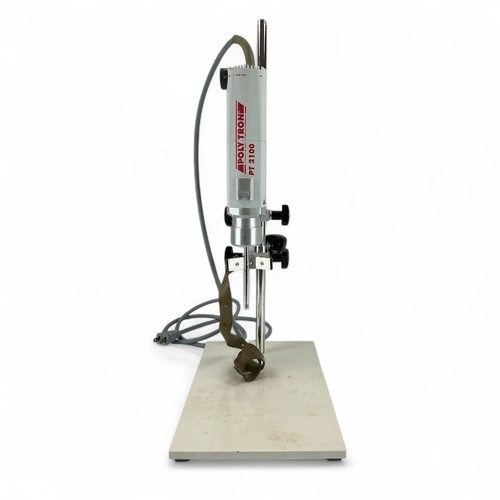
Kinematica Polytron PT MR 2100 Homogenizer .
The PT MR 2100 is a benchtop rotor-stator homogenizer designed for dispersing, emulsifying, suspending and homogenizing samples from small laboratory volumes into the liter range.

For applications requiring more motor power and larger volume flexibility, HiTechTrader also carries the:
Kinematica Polytron PT-MR-3000 Homogenizer .
The PT-MR-3000 uses interchangeable rotor-stator aggregates and can support applications ranging from small laboratory samples to multi-liter processing, depending on the installed dispersing head.
How Does an Ultrasonic Homogenizer Work?
An ultrasonic homogenizer works very differently.
A high-power ultrasonic transducer creates rapid mechanical vibrations that are transferred into a liquid through a sonotrode, probe or another ultrasonic processing interface.
The ultrasonic waves create alternating high pressure and low-pressure cycles in the liquid.
During the low-pressure phase, microscopic cavities or bubbles can form.
These bubbles grow and then collapse violently.
This phenomenon is known as acoustic cavitation.
The collapse of the cavitation bubbles produces extremely intense localized:
- shear forces
- turbulence
- liquid microjets
- particle collisions
- pressure gradients
Those forces can disrupt cells, break agglomerates apart, reduce droplet size and accelerate extraction.
Common ultrasonic homogenizer applications include:
- cell lysis
- protein extraction
- DNA/RNA sample preparation
- particle dispersion
- nanoparticle deagglomeration
- nanoemulsification
- wet milling
- chemical extraction
- degassing
- sonochemistry
HiTechTrader offers Hielscher ultrasonic homogenizers and sonicators for laboratory and process applications.
Ultrasonic Homogenization Does Not Always Require a Probe in the Sample
One important advantage of ultrasonic technology is that several processing geometries are available.
A conventional probe sonicator places the sonotrode directly into the liquid.
But ultrasonic energy can also be transmitted indirectly.
HiTechTrader currently carries two useful examples:
- Hielscher VialTweeter for processing multiple closed sample tubes.
- Hielscher 96-Well Plate Ultrasonic Mixer for high throughput multi-well sample preparation.

Rotor-Stator vs Ultrasonic Homogenizer: Side-by-Side Comparison
| Factor | Rotor-Stator Homogenizer | Ultrasonic Homogenizer |
|---|---|---|
| Primary mechanism | Mechanical rotor-stator shear | Acoustic cavitation |
| Tissue disruption | Excellent, particularly for fibrous or structured tissue | Good to excellent depending on tissue and preparation |
| Cell lysis | Useful | Excellent for many cell types |
| Routine sample homogenization | Excellent | Excellent |
| Fine particle dispersion | Good | Excellent for many fine and nano scale dispersions |
| Nanoemulsions | Can produce fine emulsions | Often especially useful when very small droplets are required |
| Fibrous material | Often an excellent choice | Application dependent |
| Small liquid samples | Depends on dispersing head | Excellent with appropriately sized sonotrode |
| Large volumes | Excellent with appropriately sized system | Scalable with larger ultrasonic processors or flow cells |
| Heat generation | Yes | Yes, potentially significant at high energy input |
| Tool contacts sample | Yes | Yes for probe sonication; no for certain indirect systems |
| Cleaning between samples | Usually required | Required for direct probes; greatly reduced with non contact systems |
| High-throughput plates | Not the typical format | Available with systems designed for multi-well processing |
Which Is Better for Tissue Homogenization?
For many conventional tissue homogenization workflows, a rotor-stator is an excellent starting point.
The mechanical action is particularly useful for samples containing:
- fibrous tissue
- muscle
- connective material
- plant material
- soft biological tissue
Interchangeable rotor-stator heads can also allow the same drive unit to handle different sample sizes and tissue types.
Ultrasonic homogenization can also disrupt biological tissue, particularly after the sample has been cut, pre-homogenized or suspended in liquid.
In some workflows, laboratories actually use both:
Rotor-stator first → ultrasonic processing second.
The rotor-stator breaks down the bulk tissue structure, while sonication performs additional disruption, extraction or fine dispersion.
Which Is Better for Cell Lysis?
Ultrasonic homogenization is widely used for cell lysis because cavitation can apply intense localized mechanical forces to cell structures.
Applications include:
- bacterial cell disruption
- mammalian cell lysis
- yeast processing
- algae disruption
- protein extraction
- intracellular compound recovery
A rotor-stator can also lyse cells and homogenize cell suspensions, but ultrasound may provide a stronger option when more intense disruption is required.
The correct method depends on the cell type and downstream target.
For example, a protocol designed to release proteins while preserving biological activity may require very different conditions from one designed for complete destructive lysis.
Which Is Better for Protein Extraction?
Both technologies can contribute to protein-extraction workflows.
A rotor-stator can rapidly break tissue into a uniform suspension and increase the surface area exposed to extraction buffer.
Ultrasound can provide additional cellular disruption and release intracellular material.
For tissue-derived proteins, a practical workflow might be:
Tissue + extraction buffer → rotor-stator homogenization → controlled sonication → centrifugation → protein-containing supernatant
Temperature control is critical because excessive heat can affect proteins and enzymes.
Which Is Better for Emulsification?
Both technologies are widely used for emulsification.
A rotor-stator homogenizer is particularly effective for rapidly combining immiscible phases and producing conventional fine emulsions.
Applications include:
- cosmetics
- creams
- lotions
- pharmaceutical formulations
- food emulsions
- chemical formulations
Ultrasonication can become particularly attractive when the target is a very fine emulsion or nanoemulsion.
Acoustic cavitation can generate intense localized forces that divide larger droplets into much smaller ones.
A useful development strategy
A formulation laboratory may begin with a rotor-stator to create a stable coarse or fine pre-emulsion and then apply ultrasound to further reduce droplet size.
This can be more efficient than asking one technology to perform every stage of the process.
Which Is Better for Nanoparticle Dispersion?
Ultrasonic homogenizers are widely used for:
- nanoparticle dispersion
- deagglomeration
- carbon-based materials
- pigments
- catalyst suspensions
- fine powders
Particles that appear small individually often form much larger agglomerates because of attractive surface forces.
Ultrasonic cavitation produces high local shear and particle collisions that can help break those agglomerates apart.
A rotor-stator may still be useful for initially wetting and incorporating powders into the liquid before ultrasonic processing.
Which Technology Handles Fibrous Samples Better?
Rotor-stator equipment frequently has an advantage with fibrous or stringy biological material.
The physical cutting and shearing action can break down structures that may otherwise remain intact in the liquid.
The exact performance depends heavily on the rotor-stator geometry.
Kinematica offers different dispersing aggregates intended for different jobs, including fibrous materials, emulsions and suspensions.
What About Very Small Samples?
Both systems can work with small volumes if configured correctly.
Rotor-stator homogenizers require a dispersing head that is appropriately sized for the sample vessel and minimum immersion depth.
Ultrasonic processors can use small-diameter sonotrodes for small liquid volumes.
For many small samples processed at once, indirect ultrasonic systems become especially interesting.
For example:
- VialTweeter for multiple closed tubes.
- 96-well plate sonication for high-throughput microplate processing.
What About Larger Volumes?
Rotor-stator systems can scale from small benchtop units to large industrial high-shear mixers.
Ultrasonic processing can also scale through:
- higher-powered ultrasonic processors
- larger sonotrodes
- flow cells
- continuous inline processing
The scale up strategy is different, however.
For a rotor-stator, engineers typically consider factors such as rotor diameter, stator geometry, tip speed, flow pattern, viscosity and batch size.
For ultrasonics, important scale-up variables include:
- amplitude
- energy input
- power density
- residence time
- pressure
- flow rate
- temperature
Which One Produces More Heat?
Both can heat the sample.
Rotor-stator homogenizers convert mechanical energy into heat through friction and shear.
Ultrasonic homogenizers generate heat through cavitation and energy dissipation.
Temperature becomes especially important when processing:
- proteins
- enzymes
- RNA
- DNA
- temperature-sensitive pharmaceuticals
- volatile compounds
Possible temperature control strategies include:
- ice baths
- jacketed vessels
- recirculating chillers
- pulse operation
- shorter processing intervals
- temperature probes
Which One Has a Greater Cross-Contamination Risk?
A standard rotor-stator head physically contacts each sample.
The dispersing head therefore needs appropriate cleaning between samples.
A direct ultrasonic probe has the same basic issue because the sonotrode also contacts the sample.
Indirect ultrasonic systems are different.
Systems such as the Hielscher VialTweeter can transmit ultrasonic energy through the walls of closed tubes.
That eliminates direct sonotrode contact with the liquid.
For laboratories concerned about sample to sample carryover, this can be a major advantage.
Rotor-Stator vs Ultrasonic Homogenizer by Application
| Application | Technology to Consider First | Why |
|---|---|---|
| Fibrous tissue homogenization | Rotor-Stator | Mechanical cutting and high shear handle structured tissue effectively. |
| General tissue sample preparation | Rotor-Stator | Versatile, fast and easy to adapt using different dispersing heads. |
| Bacterial cell lysis | Ultrasonic | Intense cavitation can provide effective cell disruption. |
| Protein extraction from tissue | Combination | Rotor-stator can break bulk tissue; ultrasound can assist further cellular disruption. |
| Conventional emulsion | Rotor-Stator | Excellent for rapid high-shear mixing of liquid phases. |
| Nanoemulsion | Ultrasonic | Cavitation can support very fine droplet formation. |
| Nanoparticle deagglomeration | Ultrasonic | High local shear and particle collisions help disrupt agglomerates. |
| Powder incorporation into liquid | Rotor-Stator | Excellent for rapid wetting and bulk dispersion. |
| 96-well cell lysis | Ultrasonic plate system | Allows parallel multi-well sample processing. |
| Closed-vial sonication | Ultrasonic | Indirect systems can process samples without opening the tube. |
Rotor-Stator vs Sonicator for Laboratory Workflow
Equipment specifications alone do not determine which homogenizer is easier to live with every day.
Think about the workflow.
A rotor-stator workflow may look like:
Load sample → immerse dispersing head → homogenize → remove head → clean head → process next sample
A direct probe-sonicator workflow may look like:
Load sample → immerse sonotrode → sonicate → remove probe → clean probe → process next sample
A high-throughput indirect ultrasonic workflow may look like:
Load tubes or plate → place entire sample format in system → run programmed cycle → remove all processed samples
The number of samples being processed can therefore change which technology is most attractive.
When a Rotor-Stator Homogenizer Is the Better Choice
Choose a rotor stator when:
- you process tissue regularly
- your samples contain fibrous or stringy material
- you need a versatile general-purpose homogenizer
- you frequently make emulsions or suspensions
- you need to incorporate powders into liquids
- you work across a wide range of viscosities
- you need interchangeable dispersing heads
- you want straightforward mechanical homogenization
When an Ultrasonic Homogenizer Is the Better Choice
Choose ultrasonic processing when:
- cell lysis is a major application
- you need strong particle deagglomeration
- you are developing nanoemulsions
- you work with nanoparticle suspensions
- you need extraction enhancement
- you require precisely controlled ultrasonic energy input
- you want closed vial processing
- you need 96-well or high-throughput sample preparation
When You May Want Both
Many advanced laboratories can justify having both technologies because the equipment solves different problems.
For example:
Tissue proteomics
Rotor-stator homogenization can perform the initial tissue breakdown, followed by ultrasonic processing for additional cell disruption and protein extraction.
Formulation development
A rotor-stator can quickly create a pre-emulsion, while ultrasound can be used to further reduce droplet size.
Nanoparticle formulations
A rotor-stator can wet and incorporate powder into the liquid, after which ultrasound can break down agglomerates more aggressively.
The question therefore does not always have to be:
“Which homogenizer should we buy?”
It may be:
“Which homogenizer should perform each stage of our process?”
What to Check When Buying a Used Rotor-Stator Homogenizer
- Verify the motor operates smoothly across the speed range.
- Check the rotor-stator head for excessive wear.
- Inspect the shaft and bearings.
- Confirm the dispersing aggregate is included.
- Determine which additional heads are compatible.
- Verify minimum and maximum working volumes.
- Check the stand and clamp.
- Confirm electrical requirements.
- Ask whether speed control has been tested.
- Inspect sample contact surfaces for corrosion or damage.
What to Check When Buying an Ultrasonic Homogenizer
- Verify the generator and transducer operate correctly.
- Inspect the sonotrode or probe for erosion.
- Confirm frequency and power output.
- Check amplitude control.
- Confirm the correct sonotrode is included for your volume.
- Determine whether a stand or clamp is included.
- Verify temperature monitoring if required.
- Check pulse and timer functions.
- Confirm any required flow cell or cooling accessories.
- For digital systems, verify controller and data recording functionality.
Current Homogenizer Options at HiTechTrader
HiTechTrader carries both mechanical and ultrasonic homogenization equipment.
Rotor-Stator
Ultrasonic
- Hielscher Sonicators and Ultrasonic Homogenizers
- Hielscher VialTweeter
- Hielscher 96-Well Plate Ultrasonic Mixer
You can also browse the complete HiTechTrader homogenizer inventory .
Frequently Asked Questions
What is the main difference between a rotor-stator and ultrasonic homogenizer?
A rotor-stator uses high mechanical shear created between a spinning rotor and stationary stator. An ultrasonic homogenizer uses high frequency mechanical vibrations to create acoustic cavitation in a liquid.
Is a sonicator the same as an ultrasonic homogenizer?
The terms are often used interchangeably. A probe sonicator is a type of ultrasonic homogenizer that transmits high intensity ultrasound into the liquid through a probe or sonotrode.
Which homogenizer is best for tissue?
Rotor-stator homogenizers are often excellent for routine tissue homogenization, especially fibrous or structured samples. Ultrasonic processing can also be useful for additional cell disruption and extraction after the bulk tissue has been broken down.
Which homogenizer is best for cell lysis?
Ultrasonic homogenizers are widely used for cell lysis because acoustic cavitation can create intense disruptive forces. The best method still depends on cell type, sample volume and the target molecule being recovered.
Can I use a rotor-stator for cell lysis?
Yes. Rotor-stator homogenizers can disrupt many cell and tissue samples. Some applications may benefit from additional sonication when more intensive cellular disruption is required.
Which is better for emulsions?
Rotor-stator homogenizers are excellent for producing conventional fine emulsions and pre-emulsions. Ultrasonic homogenizers are particularly attractive when very fine droplets or nanoemulsions are required.
Which is better for nanoparticles?
Ultrasonic processing is commonly used for nanoparticle dispersion and deagglomeration because cavitation creates intense local shear and particle collisions. Rotor-stator processing can still be useful for initial powder incorporation and bulk dispersion.
Does ultrasonic homogenization damage proteins?
It can if excessive energy or heat is applied. Protein workflows often use pulse sonication, cooling and controlled processing conditions to limit unwanted temperature rise or overprocessing.
Can rotor-stator homogenization heat a sample?
Yes. High speed mechanical shear generates heat, particularly during long processing runs or in viscous materials.
Does a rotor-stator homogenizer require cleaning between samples?
Yes, because the dispersing head contacts the sample directly. Appropriate cleaning or decontamination is important to prevent sample carryover.
Can ultrasound process samples without direct contact?
Yes. Systems such as the Hielscher VialTweeter and multi-well plate sonicators transfer ultrasonic energy through the sample container rather than inserting a probe directly into the liquid.
Which type is better for a high throughput lab?
For dozens of standardized samples, plate-based or multi-vial ultrasonic systems can provide a major throughput advantage. A rotor-stator remains useful when individual samples vary significantly in size, tissue type or vessel format.
Technical References
- Kinematica — POLYTRON Rotor-Stator Principle
- Hielscher — Ultrasonic Homogenization
- Hielscher — Acoustic Cavitation and Ultrasonicator Operation
- Hielscher — Laboratory Ultrasonic Sample Preparation
Equipment performance depends on the exact model, dispersing head or sonotrode, sample properties and process conditions. Always verify the manufacturer's documentation for the specific system before developing a method.
Related HiTechTrader Guides
- 96-Well Plate Homogenizer Guide: High-Throughput Sample Preparation
- Hielscher VialTweeter vs 96-Well Plate Sonicator
Need Help Choosing a Laboratory Homogenizer?
Send HiTechTrader the basic details of your application:
- sample type
- sample volume
- number of samples per day
- viscosity
- particle or tissue type
- desired final particle or droplet size
- whether cell lysis is required
- temperature sensitivity
- whether the process needs to scale
We can help compare rotor-stator, ultrasonic and other homogenization equipment against your actual workflow rather than simply recommending the highest-powered unit.
Contact HiTechTrader About Homogenizers
Or browse the current homogenizer inventory .