
96-Well Plate Sonication for Protein Extraction, DNA/RNA and Chromatin Workflows
5th Oct 2026
96-Well Plate Sonication for Protein Extraction, DNA/RNA and Chromatin Workflows
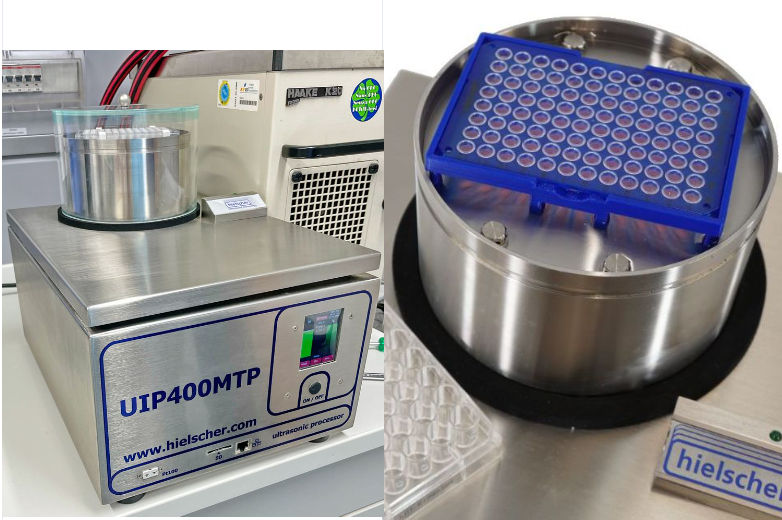
Unlike conventional probe sonication, a non contact multi-well system does not require a probe to be inserted into every individual sample. That can reduce repetitive handling, eliminate probe cleaning between wells and make the sonication step much easier to integrate with plate-based genomics, proteomics, metabolomics and screening workflows.
The key to successful plate sonication is not simply applying more power. Reproducible results depend on energy input, processing time, pulse settings, sample volume, plate type, temperature control and well to well uniformity.
Key Takeaways
- A 96-well plate sonicator can process an entire plate during one programmed sample-preparation cycle.
- Common applications include cell lysis, protein extraction, DNA shearing, RNA shearing and chromatin fragmentation.
- Non contact sonication avoids inserting the same ultrasonic probe into individual samples.
- High-throughput sonication is especially useful when the downstream workflow already uses microplates.
- Protein workflows need careful temperature control to reduce unwanted protein denaturation.
- DNA and chromatin applications require controlled fragmentation rather than maximum cell destruction.
- Well to well uniformity matters just as much as total ultrasonic power.
- The same sonicator settings should not automatically be used for proteins, genomic DNA, RNA and chromatin.
- Plate sonication can fit naturally into automated liquid handling and multi-omics workflows.
Why 96-Well Sonication Is Becoming Important in High Throughput Labs
Many laboratory workflows have already moved into microplates.
Liquid handlers dispense reagents into plates. Plate centrifuges process samples. Microplate readers measure assays. Automated stackers and robotic workstations move plates between instruments.
Sample disruption, however, is often still performed one tube at a time.
That creates a bottleneck.
A technician may need to:
- remove a sample from a rack
- open the tube
- insert an ultrasonic probe
- run the sonication cycle
- remove the probe
- clean the probe
- close the tube
- move to the next sample
Repeating that sequence dozens of times introduces significant hands-on time.
A multi-well plate sonicator changes the workflow by allowing samples to stay in the same plate format used during the rest of the experiment.
Eliminating unnecessary transfers can improve throughput and reduce opportunities for sample handling errors.
Current 96-Well Sonication Equipment at HiTechTrader
HiTechTrader currently carries the:
Hielscher 96-Well Plate Ultrasonic Mixer / Microtiter Homogenizer .
The system is designed for simultaneous high intensity ultrasonic processing of multi-well samples and is intended for applications including:
- cell lysis
- protein extraction
- cell homogenization
- cell solubilization
- DNA fragmentation
- high throughput sample preparation

You can also browse:
How Does a 96-Well Plate Sonicator Work?
High-intensity ultrasonication creates alternating pressure waves within a liquid.
During the low pressure portion of the ultrasonic cycle, microscopic cavities form.
These cavities expand and eventually collapse.
The process is called acoustic cavitation.
Cavitation generates localized:
- hydrodynamic shear
- turbulence
- pressure gradients
- liquid microjets
- particle collisions
Those forces can disrupt cell membranes, break tissue structures, release intracellular compounds and fragment nucleic acids.
A dedicated plate sonicator transfers this energy into samples across the multi-well plate rather than requiring a separate probe insertion into every well.
96-Well Sonication for Protein Extraction
Protein extraction is one of the strongest applications for high throughput sonication.
Proteomic experiments frequently begin with dozens or hundreds of biological samples.
If each sample is lysed separately, sample preparation can consume substantial technician time before the samples ever reach:
- Western blotting
- ELISA
- mass spectrometry
- protein quantification
- enzyme assays
- immunoprecipitation
- other proteomic analyses
Plate sonication allows many samples to receive a standardized disruption step during the same run.
What happens during ultrasonic protein extraction?
The goal is normally to:
- disrupt the cells or tissue
- release intracellular proteins into the extraction buffer
- solubilize the target material sufficiently for downstream separation or analysis
After sonication, samples are commonly centrifuged so insoluble debris can be separated from the protein containing supernatant.
A typical high throughput protein workflow
Why Temperature Control Matters for Proteins
Ultrasonic energy generates heat.
That is one of the most important variables in protein extraction.
Excessive heating can potentially affect:
- protein conformation
- enzyme activity
- protein-protein interactions
- temperature sensitive biomarkers
Useful strategies can include:
- pulse sonication
- cooling the plate
- using shorter processing intervals
- pre-chilling samples
- monitoring temperature during method development
The objective should be sufficient lysis and extraction with the minimum unnecessary energy input.
96-Well Sonication for DNA Fragmentation
Ultrasonic energy can also be used intentionally to shear genomic DNA into smaller fragments.
This can be useful in workflows involving:
- next generation sequencing
- library preparation
- genomic analysis
- molecular biology
- DNA-protein interaction studies
For these applications, the objective is fundamentally different from simple cell lysis.
During cell lysis, the question is:
“Did we release the intracellular material?”
During DNA shearing, the question becomes:
“Did we produce the desired fragment-size distribution?”
That means parameters need to be validated against the final DNA fragment profile rather than simply against processing time.
Variables That Affect DNA Fragment Size
Important variables can include:
- ultrasonic amplitude
- total energy input
- processing duration
- pulse cycle
- DNA concentration
- sample volume
- plate geometry
- temperature
Increasing sonication energy or time will generally increase fragmentation, but the exact relationship must be experimentally established for the sample and method.
Fragment size can be evaluated using methods such as:
- agarose gel electrophoresis
- capillary electrophoresis
- automated nucleic-acid fragment analyzers
Protecting DNA When Fragmentation Is Not Desired
Not every DNA extraction workflow wants fragmented DNA.
If the objective is high molecular weight genomic DNA, aggressive sonication may be undesirable.
In that case, the lysis method should use only enough energy to disrupt the cells while minimizing unnecessary shearing.
This is another reason the phrase “more powerful homogenization” does not automatically mean “better sample preparation.”
96-Well Sonication for RNA Workflows
Ultrasonication can also be used in RNA related sample preparation and controlled RNA shearing.
RNA workflows deserve particular attention because RNA can be highly sensitive to degradation.
Good technique may require careful control of:
- temperature
- processing duration
- RNase contamination
- sample handling time
- buffer chemistry
The goal may differ depending on the experiment.
For some workflows, researchers want efficient lysis and high RNA recovery with minimal fragmentation.
For others, controlled fragmentation may be intentional.
The sonication protocol must therefore match the downstream objective.
DNA Extraction vs DNA Shearing: They Are Not the Same Process
| Goal | Desired Sonication Effect | Primary Validation |
|---|---|---|
| DNA extraction | Disrupt cells and release nucleic acids while preserving desired DNA integrity | DNA yield, purity and integrity |
| DNA shearing | Deliberately fragment DNA to a controlled size distribution | Fragment size profile |
| Chromatin shearing | Fragment chromatin into appropriately sized DNA-protein complexes | Fragment size range and downstream ChIP performance |
96-Well Sonication for Chromatin Shearing
Chromatin shearing is an important application in epigenetics and chromatin immunoprecipitation workflows.
Chromatin consists of DNA associated with histones and other proteins.
For many ChIP and ChIP-seq workflows, the chromatin must be fragmented into an appropriate size range before immunoprecipitation and downstream analysis.
Sonication is widely used for this fragmentation step.
Why plate based chromatin shearing is attractive
Traditional ChIP workflows can involve processing many individual samples separately.
Moving the shearing step to a multi-well plate can improve:
- throughput
- sample to sample consistency
- operator efficiency
- automation potential
- standardization across experiments
A simplified ChIP preparation workflow
How Much Should Chromatin Be Sheared?
The optimum fragment size depends on the specific ChIP protocol, antibody, downstream analytical method and experimental objective.
That means laboratories should not simply copy a sonication time from another instrument or publication and assume identical results.
Method development should evaluate:
- cell type
- cell concentration
- cross linking conditions
- sample volume
- plate format
- ultrasonic amplitude
- processing duration
- temperature
Why Uniformity Across 96 Wells Matters
The central value of high throughput processing is consistency.
If the wells in the center receive one effective energy input while corner wells behave differently, the system creates another source of experimental variability.
A validation study should therefore compare different plate positions.
Depending on the application, compare:
- protein yield
- DNA concentration
- DNA fragment size
- RNA recovery
- chromatin fragment profile
- cell-lysis efficiency
Sample positions should include:
- center wells
- edge wells
- corner wells
Plate Type Can Influence Sonication
Multi-well plates differ in more ways than sample capacity.
Variables include:
- polymer material
- plate rigidity
- well-bottom thickness
- flat, round or conical well geometry
- working volume
- seal type
Those physical differences can influence ultrasonic energy transfer and sample behavior.
Hielscher's current UIP400MTP platform is designed for standard multi-well formats and supports a range of plate types rather than requiring only a single proprietary consumable.
Nevertheless, once a laboratory validates a plate and protocol combination, it is usually best to keep that combination consistent during routine experiments.
Sample Volume Matters More Than Many Labs Expect
Changing sample volume changes:
- liquid depth
- energy density
- heat accumulation
- mixing behavior
- fragmentation behavior
A method optimized for 50 µL should not automatically be assumed to produce identical results at 200 µL.
When method development is performed, sample volume should be treated as a controlled experimental parameter.
Pulse Sonication vs Continuous Sonication
Many biological applications benefit from pulsed sonication.
Instead of applying ultrasound continuously, the system alternates between processing and rest periods.
Potential advantages include:
- better temperature control
- more controlled energy delivery
- reduced risk of excessive heating
- greater method flexibility
Continuous sonication may still be appropriate for some processes.
The correct setting should be determined experimentally.
96-Well Sonication for Multi-Omics Workflows
High-throughput sample preparation becomes especially valuable when one biological experiment generates data for multiple analytical platforms.
Examples include combining:
- proteomics
- genomics
- transcriptomics
- metabolomics
- lipidomics
A standardized plate based disruption method can reduce one major source of variation at the beginning of the workflow.
Plate sonication can also integrate well with:
- automated liquid handlers
- plate centrifuges
- robotic plate movers
- automated extraction systems
96-Well Sonication for Adherent Cell Cultures
Plate based sonication can be particularly interesting when cells are already being cultured in multi-well plates.
Rather than manually scraping every well and transferring samples into separate tubes, some workflows can process the cells directly within a plate-based sample-preparation sequence.
That can reduce:
- manual scraping
- transfer steps
- sample loss
- operator to operator variation
The suitability of direct plate processing depends on the specific cell line, buffer, plate and downstream assay.
96-Well Sonication for FFPE Samples
Formalin fixed paraffin embedded tissue presents unique sample-preparation challenges because fixation creates chemical cross-links and the sample may require specialized extraction chemistry.
High- ntensity sonication can be used as part of workflows designed to extract biomolecules from FFPE material.
As with other applications, the sonication step should be validated together with the complete extraction protocol rather than treated as an isolated process.
Protein Extraction vs DNA Shearing vs Chromatin: What Changes?
| Application | Main Objective | Primary Risk of Overprocessing | What to Measure |
|---|---|---|---|
| Protein extraction | Maximize recovery while preserving useful protein properties | Heat, denaturation or excessive degradation | Protein yield and downstream function/assay performance |
| DNA extraction | Release nucleic acid | Unwanted fragmentation | Yield, purity and DNA integrity |
| DNA shearing | Create controlled fragments | Fragments becoming smaller than required | Fragment-size distribution |
| RNA workflow | Extract or intentionally shear RNA depending on method | Uncontrolled RNA degradation | Yield and RNA integrity / fragment profile |
| Chromatin shearing | Create reproducible chromatin fragments | Over or under fragmentation | Fragment distribution and ChIP performance |
How to Develop a 96-Well Sonication Protocol
A good method-development process changes one parameter at a time instead of randomly increasing power and duration.
Step 1: Define the analytical endpoint
Decide exactly what success means.
Examples:
- maximum soluble protein yield
- specific DNA fragment range
- intact RNA recovery
- specific chromatin fragment distribution
- minimum percentage of lysed cells
Step 2: Standardize the starting sample
Control:
- cell count
- tissue mass
- sample concentration
- buffer composition
- sample volume
Step 3: Establish a conservative starting condition
Begin with enough ultrasonic energy to observe an effect without immediately maximizing the process.
Step 4: Monitor temperature
Measure the actual temperature reached during processing rather than assuming cooling is adequate.
Step 5: Evaluate the endpoint
Measure the property that matters to the experiment.
Step 6: Check well to well uniformity
Repeat the measurements across different plate positions.
Step 7: Test reproducibility
Repeat the optimized protocol on a different plate and, ideally, on a different day.
Common 96-Well Sonication Mistakes
1. Using maximum power by default
Maximum power is not the same as an optimized method.
2. Ignoring temperature
Two runs with identical timer settings but different final temperatures may not be equivalent.
3. Changing plates without revalidation
Different materials and geometries can alter energy transfer.
4. Assuming all wells behave identically
Check corner, edge and center wells during development.
5. Optimizing lysis but ignoring analyte quality
A sample can be completely lysed while the protein, DNA or RNA has been processed more aggressively than the assay requires.
6. Copying a probe sonicator protocol directly to a plate system
The energy transfer geometry is different. The method should be reoptimized.
When Does a 96-Well Sonicator Make Sense?
A multi-well sonicator becomes particularly valuable when:
- you process dozens of biological samples per experiment
- probe sonication has become a labor bottleneck
- the downstream assay already uses plates
- you need standardized treatment across a sample cohort
- your laboratory is moving toward automation
- cross contamination from repeated probe contact is a concern
- you perform genomics, proteomics or other high throughput studies
When Might a VialTweeter Be Better?
Not every high throughput workflow should move to plates.
If you typically process fewer samples and those samples need to remain in individual closed tubes, the Hielscher VialTweeter may be more practical.
Read: Hielscher VialTweeter vs 96-Well Plate Sonicator .
Frequently Asked Questions
Can a 96-well sonicator extract proteins?
Yes. High intensity multi-well sonication can disrupt cells and improve release of intracellular proteins into extraction buffer. The method should control temperature and energy input to protect proteins required for downstream analysis.
Can you sonicate a 96-well plate?
Yes. Dedicated multi-well plate sonicators are designed specifically to apply ultrasonic energy across standard microplate formats.
Can 96-well sonication be used for cell lysis?
Yes. Cell disruption and lysis are major applications of high throughput plate sonication.
Can 96-well sonication fragment DNA?
Yes. Controlled ultrasonication can shear DNA into smaller fragments. Processing conditions should be optimized against the required fragment-size distribution.
Can a plate sonicator shear RNA?
Yes. High intensity ultrasound can fragment RNA, although the protocol must be carefully controlled because RNA integrity requirements vary by downstream application.
Can a 96-well sonicator shear chromatin?
Yes. Plate sonication can be used to fragment chromatin for ChIP and related epigenetics workflows. Fragment size should be verified experimentally.
Is chromatin shearing the same as DNA fragmentation?
No. DNA fragmentation refers broadly to reducing DNA fragment size. Chromatin shearing involves fragmenting DNA while it is associated with proteins and other chromatin components, often as part of ChIP workflows.
Does sonication damage proteins?
Excessive ultrasonic energy or heat can adversely affect sensitive proteins. Controlled processing, pulse operation and cooling can reduce that risk.
Does sonication damage DNA?
Sonication intentionally fragments DNA when sufficient energy is applied. If intact high molecular weight DNA is required, the method should minimize unnecessary ultrasonic exposure.
How do I prevent samples from heating during sonication?
Common strategies include pulse mode processing, chilled samples, active cooling, shorter sonication intervals and temperature monitoring.
Is a plate sonicator the same as an ultrasonic bath?
No. High-intensity multi-well sonicators are designed to deliver focused, controllable ultrasonic energy for sample preparation. Conventional ultrasonic cleaning baths generally provide much lower and less precisely controlled energy density.
Can a 96-well sonicator work with different plate formats?
Systems designed for multi-well processing can support multiple standard plate formats. The exact plate type, volume and geometry should still be validated for the application.
Is 96-well sonication useful for proteomics?
Yes. Parallel cell lysis and protein extraction can help standardize sample preparation across larger proteomic studies and reduce repetitive manual processing.
Is 96-well sonication useful for genomics?
Yes. Applications include cell lysis, nucleic-acid extraction and controlled DNA/RNA fragmentation for genomic workflows.
Related HiTechTrader Guides
- 96-Well Plate Homogenizer Guide: High-Throughput Sample Preparation
- Best Homogenizer for Cell Lysis: Ultrasonic vs Rotor-Stator vs Bead Mill
- Hielscher VialTweeter vs 96-Well Plate Sonicator
- Rotor-Stator vs Ultrasonic Homogenizer
Need a 96-Well Sonicator for Protein, DNA/RNA or Chromatin Work?
Send HiTechTrader the basic details of your workflow:
- sample type
- cell or tissue type
- plate format
- sample volume per well
- number of samples
- whether the target is protein, DNA, RNA or chromatin
- desired DNA/chromatin fragment range if applicable
- temperature sensitivity
- downstream analytical method
- whether laboratory automation is planned
We can help compare available ultrasonic sample preparation equipment with the needs of your protocol.
Contact HiTechTrader About 96-Well Sonication
Or view the current: Hielscher 96-Well Plate Ultrasonic Mixer .